Starting a coloring hobby is exciting, but choosing the right supplies can feel confusing when you see so many options. Colored pencils, crayons, markers, gel pens, paper, and coloring books all offer different experiences. The good news is that beginners do not need to buy everything at once.
The best approach is to start with a few basic supplies that match your age, budget, coloring style, and the type of coloring pages you enjoy.
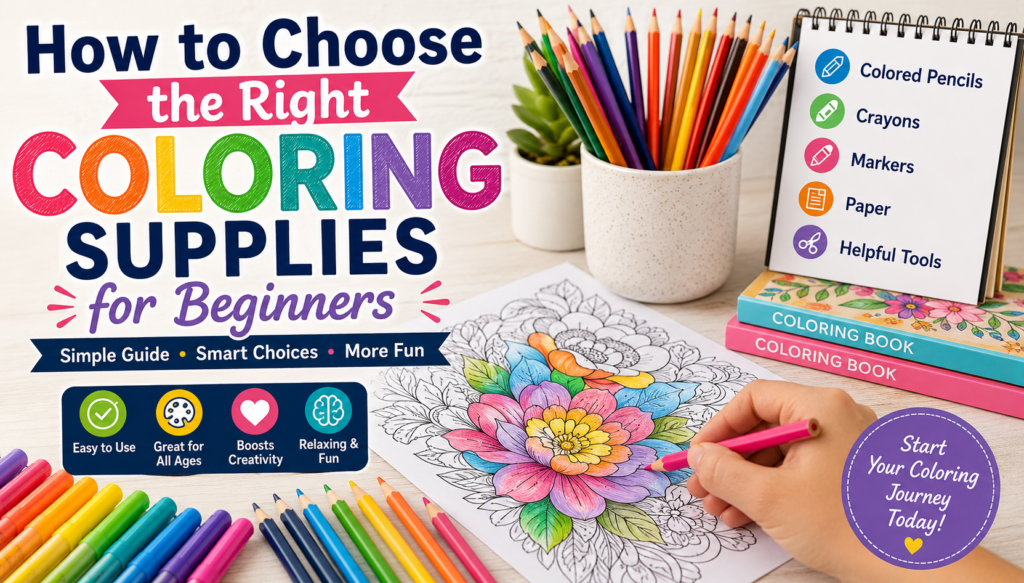
This guide explains how to choose the right coloring supplies for beginners, including colored pencils, crayons, markers, paper, and other useful tools. Whether you are buying supplies for a child, teenager, or adult, these tips can help you create a simple and enjoyable coloring setup.
Quick Answer
For most beginners, the easiest coloring supplies to start with are:
- Colored pencils for control and detail.
- Crayons for young children.
- Washable markers for bold, bright colors.
- Medium or thick paper for better durability.
- A simple coloring book or printable coloring pages.
- A sharpener and eraser for colored pencil users.
You do not need expensive supplies to enjoy coloring. Start with good basic tools and experiment with different materials as you discover what you enjoy.
Why Choosing the Right Coloring Supplies Matters
The supplies you use can affect your overall coloring experience.
For example, a young child may find crayons easier to hold than fine-tip colored pencils. Someone coloring detailed mandala designs may prefer colored pencils or gel pens. A person who enjoys bold, vibrant artwork may prefer markers.
Choosing suitable supplies can help you:
- Feel more comfortable while coloring.
- Create cleaner results.
- Explore different coloring styles.
- Avoid unnecessary spending.
- Match your tools with the right coloring pages.
- Enjoy the activity for longer.
There is no single “best” coloring supply for everyone. The right choice depends on the person and the type of artwork being colored.
Start With Your Coloring Goals
Before buying coloring supplies, think about what you want to color.
Ask yourself:
- Are you buying supplies for a child or an adult?
- Do you prefer simple or detailed designs?
- Do you want bright, bold colors or soft shading?
- Are you using physical coloring books or printable coloring pages?
- Will you mostly color at home or while traveling?
- What is your budget?
Your answers can help you choose supplies more effectively.
For example, someone coloring large animal pages may not need the same tools as someone working on intricate fantasy or mandala coloring pages.
The Best Coloring Supplies for Beginners
Beginners can usually start with a small collection of essential tools.
Colored Pencils
Colored pencils are one of the most popular options for beginners.
They provide good control and make it easier to color small sections of a design. They can also be used for layering, shading, and experimenting with different levels of pressure.
Why Colored Pencils Are Good for Beginners
Colored pencils offer several advantages:
- Easy to control.
- Suitable for detailed coloring.
- Available in many colors.
- Useful for both kids and adults.
- Less likely to bleed through paper than markers.
- Easy to carry and store.
They are particularly useful for detailed coloring books and printable coloring pages.
Tips for Using Colored Pencils
Beginners can get better results by:
- Starting with light pressure.
- Adding darker layers gradually.
- Keeping pencils sharp for detailed areas.
- Using broader pencil strokes for larger spaces.
- Testing colors before using them on an important section.
You do not need a huge set of pencils when starting. A basic collection with a good range of colors is usually enough.
Crayons for Young Beginners
Crayons are a classic choice for toddlers and younger children.
They are simple to use and work well with coloring pages that have large shapes and bold outlines.
Crayons are especially useful for:
- Toddlers.
- Preschool-age children.
- Beginners practicing hand control.
- Simple coloring activities.
Young children may find larger crayons easier to hold than thin coloring tools.
When choosing crayons, consider selecting products that are designed for the child’s age group and are appropriate for regular creative activities.
Markers for Bright and Bold Coloring
Markers can create bright, smooth, and colorful results.
They are often popular with children, teens, and adults who enjoy strong colors.
However, markers require more attention because some types can show through thin paper.
Markers Work Well for:
- Large coloring areas.
- Bold illustrations.
- Simple designs.
- Posters and creative projects.
- Bright fantasy coloring pages.
For beginners, washable markers can be a practical choice for children’s activities.
For detailed coloring, fine-tip markers may offer more control.
Gel Pens for Decorative Details
Gel pens can add bright colors and small details to coloring pages.
They are particularly useful for:
- Stars.
- Jewelry.
- Small patterns.
- Decorative borders.
- Fine details.
They can also provide a different texture compared with pencils or crayons.
However, gel pens may not be the easiest option for coloring very large areas. They are often best used as an additional tool rather than the only supply in a beginner’s coloring kit.
Comparing Popular Coloring Supplies
| Coloring Supply | Best For | Beginner Friendly | Detail Level |
|---|---|---|---|
| Colored pencils | Kids, teens and adults | Yes | High |
| Crayons | Toddlers and young kids | Yes | Low to medium |
| Markers | Bold and colorful designs | Yes | Medium |
| Gel pens | Small decorative details | Yes | High |
| Water-based tools | Creative experimentation | Moderate | Medium |
For most beginners, colored pencils or crayons are an easy place to start.
Choosing the Right Coloring Paper
Paper is just as important as the coloring tool.
Thin paper may work well for crayons and colored pencils, but markers can sometimes show through the page.
If you are using printable coloring pages, you may have more control over your paper choice.
Standard Printer Paper
Standard printer paper is suitable for:
- Crayons.
- Colored pencils.
- Light coloring activities.
- Simple printable pages.
It is affordable and easy to use.
Thicker Paper
Thicker paper may be a better choice for:
- Markers.
- Gel pens.
- Heavy coloring.
- Detailed artwork.
Before using very thick paper, make sure your printer supports it.
Match Your Supplies With the Coloring Page
Not every coloring page requires the same tools.
Simple Coloring Pages
Simple coloring pages with large spaces are suitable for:
- Crayons.
- Broad markers.
- Thick colored pencils.
These pages can be ideal for toddlers and young children.
Detailed Coloring Pages
Detailed designs may work better with:
- Sharp colored pencils.
- Fine-tip markers.
- Gel pens.
Mandala coloring pages, fantasy illustrations, and intricate adult coloring books often include small spaces that require more precision.
Printable Coloring Pages
Printable coloring pages allow you to choose the paper that works best with your supplies.
For example:
- Print on standard paper for colored pencils.
- Choose thicker paper for markers.
- Print another copy if you want to experiment with a different color combination, depending on the terms of use.
This flexibility is one reason printable coloring pages can be useful for beginners.
How Many Colors Do Beginners Need?
You do not need hundreds of colors to start coloring.
A basic set can already provide enough variety for most coloring pages.
A beginner-friendly color collection may include:
- Red
- Blue
- Yellow
- Green
- Orange
- Purple
- Pink
- Brown
- Black
- Gray
- White
As you become more confident, you may want additional shades for blending and more detailed color combinations.
A smaller collection can also make it easier for beginners to learn how different colors work together.
Should Beginners Choose Cheap or Expensive Supplies?
Expensive supplies are not always necessary.
When you are starting, it can be better to purchase reliable basic supplies rather than investing immediately in a large professional collection.
A practical beginner approach is:
- Start with a basic set.
- Use the supplies regularly.
- Identify which tools you enjoy most.
- Upgrade specific supplies later.
For example, if you discover that you enjoy detailed adult coloring books, you may later decide to invest in a larger colored pencil collection.
If you prefer bold coloring with strong colors, you may choose to explore better markers.
Your own experience will help you decide where it makes sense to spend more.
Essential Coloring Tools for a Beginner Kit
A simple beginner coloring kit can include:
Colored Pencils or Crayons
Choose one based on the user’s age and preferred coloring style.
A Pencil Sharpener
Useful if you are using colored pencils.
A sharp pencil can make detailed coloring easier.
An Eraser
A standard eraser may be useful for removing graphite pencil marks if you sketch lightly before coloring.
Printable Coloring Pages or Coloring Books
Choose themes that you genuinely enjoy.
Popular options include:
- Animals
- Fantasy
- Dinosaurs
- Flowers
- Mandalas
- Cozy scenes
- Educational activities
A Flat Coloring Surface
A comfortable table or desk can make coloring easier.
Good lighting can also help you see details and colors clearly.
Tips for Choosing Coloring Supplies for Kids
When buying supplies for children, focus on simplicity and age-appropriate use.
For Toddlers
Consider:
- Large crayons.
- Simple coloring pages.
- Large outlines.
- Easy-to-hold supplies.
Avoid giving very young children overly complicated tools that may be difficult to control.
For Young Kids
Good options can include:
- Crayons.
- Colored pencils.
- Washable markers.
- Animal and educational coloring pages.
For Older Kids
Older children may enjoy:
- Larger colored pencil sets.
- Fine-tip markers.
- Fantasy coloring pages.
- Detailed themes.
- Creative activity books.
Letting children choose themes based on their interests can also make coloring more engaging.
Tips for Choosing Coloring Supplies for Teens
Teens may prefer more creative freedom and detailed designs.
Useful options can include:
- Colored pencils.
- Fine-tip markers.
- Gel pens.
- Brush pens designed for creative artwork.
Popular themes may include fantasy, fashion, animals, cozy scenes, nature, and imaginative designs.
A variety of tools can help teens experiment with different coloring styles.
Tips for Choosing Coloring Supplies for Adults
Adults often choose coloring supplies based on comfort, detail, and personal preferences.
Colored pencils are a popular starting point because they provide good control.
Adults may also enjoy combining tools, such as:
- Colored pencils for shading.
- Markers for larger areas.
- Gel pens for highlights and details.
You do not need to use every supply on the same page. Experimenting with different tools can help you find a comfortable style.
Common Mistakes Beginners Should Avoid
Buying Too Many Supplies Immediately
It is easy to purchase a large collection of tools before knowing what you enjoy.
Start simple.
Using the Wrong Paper
Thin paper may not work well with certain markers.
Match the paper with your coloring tools.
Pressing Too Hard
When using colored pencils, heavy pressure can make it more difficult to create gradual shading.
Start lightly and add color slowly.
Choosing Overly Detailed Pages
Beginners may feel frustrated if their first coloring page has hundreds of tiny sections.
Start with simpler designs and gradually try more detailed pages.
Comparing Your Work With Others
Coloring is a creative activity, and different people enjoy different styles.
Focus on experimenting and finding what works for you.
A Simple Beginner Coloring Setup
If you want to start without overthinking your supplies, try this basic setup:
- One coloring book or printable coloring page collection.
- A basic set of colored pencils.
- A sharpener.
- Standard printer paper.
- A few markers for experimentation.
This simple collection is enough for many beginners.
Later, you can add new supplies based on your interests.
How to Test New Coloring Supplies
Before using new supplies on a detailed page, test them on a spare piece of paper.
Try:
- Light pressure.
- Heavy pressure.
- Layering colors.
- Coloring large areas.
- Coloring small details.
This can help you understand how the tool feels and how the colors appear on the paper.
Testing supplies is especially useful when combining markers, colored pencils, and gel pens.
Build Your Coloring Collection Over Time
A good coloring collection does not need to be purchased all at once.
You can slowly add supplies based on your interests.
For example:
Start with:
Colored pencils and a few coloring pages.
Next:
Add markers if you enjoy brighter colors.
Later:
Try gel pens for decorative details.
As you gain experience:
Explore different paper types and more color shades.
Building your collection gradually can help you avoid buying supplies that you rarely use.
Frequently Asked Questions
What are the best coloring supplies for beginners?
Colored pencils are a versatile option for many beginners because they offer good control and work well for both simple and detailed coloring pages.
Are crayons or colored pencils better for beginners?
Crayons are often easier for toddlers and younger children, while colored pencils may be better for beginners who want more control and detail.
What paper is best for coloring pages?
Standard printer paper can work well with crayons and colored pencils. Thicker paper may be more suitable for markers and heavier coloring.
Do beginners need expensive coloring supplies?
No. A basic set of good-quality supplies is usually enough to begin. You can upgrade later as you discover which tools you enjoy using.
How many colored pencils should a beginner buy?
A basic set with a useful range of colors is usually enough. You can add more shades later if you want to experiment with blending and detailed color combinations.
Can beginners use markers in coloring books?
Yes. Markers can be easy and fun to use, especially for bold designs. However, thicker paper may help reduce problems such as bleed-through.
Conclusion
Choosing the right coloring supplies for beginners does not need to be complicated. The best place to start is with a few simple tools that match your age, interests, and coloring style.
Colored pencils offer control and versatility, crayons are ideal for many young children, and markers can create bright and bold results. Choosing the right paper can also improve your coloring experience, especially when working with different types of pens and markers.
Instead of buying every coloring tool available, start with the basics and experiment over time. As you discover whether you enjoy detailed designs, bold colors, shading, fantasy artwork, animals, mandalas, or simple printable coloring pages, you can build a collection that suits your personal style.
Explore more coloring books, printable coloring pages, and creative activities at ColoringBookArt.com and find new designs to practice your coloring skills and enjoy more creative time.