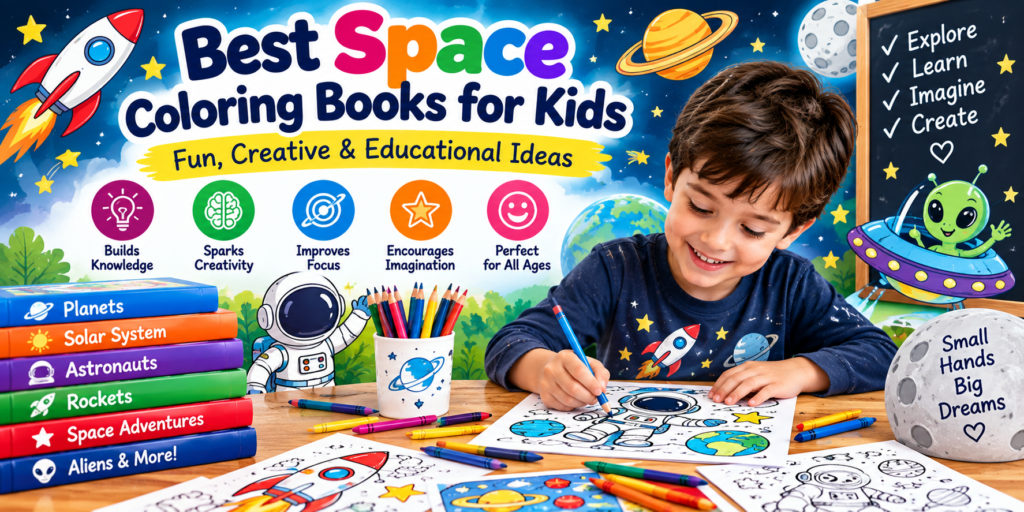
Space is one of the most fascinating subjects for curious children. Planets, stars, rockets, astronauts, moons, galaxies, and mysterious black holes can turn a simple creative activity into an exciting journey beyond Earth.
That makes space coloring books for kids a great choice for children who love science, astronomy, exploration, and imaginative adventures.
A space coloring book doesn’t have to be a formal science lesson. Children can simply enjoy choosing colors for planets and spaceships, creating colorful galaxies, or imagining themselves traveling through space. At the same time, parents and teachers can use the illustrations as an easy starting point for conversations about the solar system, astronauts, planets, stars, and space exploration.
Whether you’re looking for a simple coloring book for a preschooler or a detailed space-themed coloring book for an older child, there are many styles and subjects to choose from.
In this guide, we’ll explore the best types of space coloring books, age-appropriate designs, popular space themes, educational activity ideas, printable options, and practical tips for choosing the right coloring book.
Quick Answer: What Are the Best Space Coloring Books for Kids?
The best space coloring book depends on the child’s age and interests.
Popular choices include:
- Planet coloring books
- Solar system coloring books
- Astronaut coloring books
- Rocket coloring books
- Space adventure coloring books
- Moon coloring books
- Galaxy coloring books
- Alien-themed coloring books
- Star and constellation coloring books
- Educational space coloring books
For toddlers and younger preschoolers, choose large, simple illustrations with familiar space objects. Older children may enjoy detailed solar-system scenes, astronauts, spacecraft, galaxies, and imaginative space adventures.
Why Do Kids Love Space Coloring Books?
Space combines science with imagination.
Children can see a picture of a rocket and imagine launching into space. They can color planets and wonder what those worlds might look like. A picture of an astronaut can lead to questions about what astronauts do and how they travel beyond Earth.
This combination makes a space coloring book different from an ordinary coloring activity.
Children can use space-themed coloring books to:
- Explore their imagination
- Learn new vocabulary
- Recognize planets and space objects
- Practice creative coloring
- Create stories
- Ask questions about science
- Explore the solar system
- Enjoy independent creative time
The activity doesn’t need to be complicated. Sometimes simply coloring a planet while talking about it can create a useful learning opportunity.
Popular Types of Space Coloring Books
There are many different ways to approach the space theme. Choosing one that matches the child’s interests can make coloring more enjoyable.
1. Solar System Coloring Books
Solar system coloring books introduce children to planets and other familiar objects in our planetary neighborhood.
Pages may include:
- Sun
- Mercury
- Venus
- Earth
- Mars
- Jupiter
- Saturn
- Uranus
- Neptune
- Moons
- Asteroids
These books are particularly useful for children who are beginning to learn about the planets.
Parents can ask children to identify each planet or compare their sizes.
2. Astronaut Coloring Books
Astronaut coloring books focus on people exploring space.
Illustrations may show astronauts:
- Walking on the Moon
- Working inside spacecraft
- Exploring another world
- Wearing spacesuits
- Preparing for a mission
- Looking at Earth from space
These pages can encourage imaginative storytelling.
A child might create a story about an astronaut traveling to a distant planet or discovering a new world.
3. Rocket Coloring Books
Rockets are among the most recognizable symbols of space exploration.
Rocket coloring books can feature:
- Launch scenes
- Space stations
- Astronauts
- Countdown sequences
- Planetary missions
- Space travel
- Futuristic spacecraft
Younger children often enjoy simple rocket illustrations, while older kids may prefer detailed spacecraft designs.
4. Planet Coloring Books
A planet-focused coloring book can give children an opportunity to explore different planetary appearances.
Instead of simply coloring a generic circle, children can learn that planets have different characteristics.
For example, they may recognize:
- Earth’s blue and green appearance
- Saturn’s famous rings
- Mars’s reddish appearance
- Jupiter’s large size
- Neptune’s blue appearance
Parents can encourage children to learn about each planet while they color.
5. Galaxy and Star Coloring Books
Children who enjoy imaginative artwork may prefer galaxy-themed coloring books.
Pages can include:
- Stars
- Galaxies
- Nebulas
- Moons
- Constellations
- Comets
- Meteors
- Deep-space scenes
These designs can provide more freedom for experimenting with colors and patterns.
6. Space Adventure Coloring Books
Adventure-themed coloring books combine space objects with imaginative storytelling.
A page might show an astronaut landing on an unfamiliar planet or a spaceship traveling through a field of stars.
These books are excellent for encouraging children to invent stories around their artwork.
7. Space and Alien Coloring Books
Some children prefer the imaginative side of space.
These coloring books can include friendly fictional aliens, unusual planets, flying saucers, futuristic cities, and imaginary creatures.
Because these are fantasy themes, children have complete freedom to create their own colors and characters.
Best Space Coloring Books by Age
The complexity of the artwork should match the child’s age and coloring experience.
| Age Group | Recommended Space Coloring Book | Illustration Style |
|---|---|---|
| Toddlers | Simple space coloring books | Large planets and rockets |
| Preschoolers | Solar system and astronaut books | Simple to moderate detail |
| Ages 5–7 | Planet and space adventure books | Moderate detail |
| Ages 8–12 | Detailed astronomy coloring books | More complex scenes |
| Teens | Artistic space coloring books | Detailed galaxies and patterns |
These are general recommendations. A child’s individual interests and experience should always be considered.
Space Coloring Books for Toddlers
Toddlers can enjoy space themes even when they don’t understand astronomy yet.
Choose books featuring:
- Large planets
- Big stars
- Simple rockets
- Friendly astronauts
- Large moons
- Minimal background details
A page showing one large rocket may be easier for a toddler than a complex solar-system diagram.
At this stage, the goal is creative exploration.
Parents can name objects while children color them:
“This is a rocket.”
“This is the Moon.”
“Can you find the star?”
Simple conversations can make the activity more interactive.
Space Coloring Books for Preschoolers
Preschoolers can begin exploring recognizable space concepts.
Popular themes include:
- Planets
- The Moon
- Sun and stars
- Rockets
- Astronauts
- Space stations
- Friendly aliens
- Solar system scenes
Parents can introduce simple space vocabulary while children color.
Words such as planet, rocket, astronaut, Moon, star, Earth, and space can become part of everyday conversations.
Space Coloring Books for Older Kids
Older children may enjoy more detailed and educational illustrations.
Consider:
- Detailed planets
- Solar system scenes
- Astronaut missions
- Space stations
- Rockets
- Galaxies
- Constellations
- Space exploration
- Science-themed illustrations
Older children can also combine coloring with writing activities by adding facts or descriptions to their finished artwork.
Educational Benefits of Space Coloring Books
A space coloring book can provide more than creative entertainment.
Learning Planet Names
A solar system coloring book can help children become familiar with the names of the planets.
Repeated exposure can make unfamiliar names easier to recognize.
Exploring Space Vocabulary
Space-themed illustrations naturally introduce words such as:
- Planet
- Orbit
- Moon
- Star
- Galaxy
- Astronaut
- Rocket
- Satellite
- Comet
- Asteroid
Parents can explain unfamiliar words using simple, age-appropriate language.
Encouraging Scientific Curiosity
A coloring page can lead to questions.
A child might ask:
“Why does Saturn have rings?”
“How do astronauts get into space?”
“Why does the Moon look different sometimes?”
These questions can become opportunities for further learning.
Encouraging Imagination
Space is an ideal subject for storytelling.
Children can imagine:
- Discovering a new planet
- Traveling to Mars
- Meeting an alien
- Building a space station
- Exploring another galaxy
This makes space coloring books useful for both science-related learning and creative play.
10 Fun Activities to Do With a Space Coloring Book
A finished coloring page can be the beginning of another activity.
1. Make a Solar System
Color individual planets and arrange them in the correct order.
2. Learn Planet Names
Ask children to name the planets they have colored.
3. Create an Astronaut Story
Have the child invent a story about an astronaut exploring space.
4. Design a New Planet
After coloring the existing planets, ask the child to invent an imaginary one.
Give it a name, color, atmosphere, and inhabitants.
5. Create a Space Mission
Choose a destination and invent a mission.
For example:
Mission: Explore Mars
Children can draw the spacecraft, astronaut, destination, and discoveries.
6. Make a Constellation Picture
Color stars and connect selected ones to create an imaginary constellation.
7. Design a Spacecraft
Ask children to draw their own spaceship.
They can decide what it looks like and where it travels.
8. Create a Space Vocabulary List
Older children can write down new words they learned from the coloring book.
9. Make a Space Wall
Display completed space coloring pages together to create a mini space gallery.
10. Combine Coloring With Reading
Pair the coloring activity with an age-appropriate children’s book about planets, astronauts, or space exploration.
How to Choose the Best Space Coloring Book
Before choosing a space coloring book, consider these factors.
Consider the Child’s Age
Simple pages are usually easier for younger children, while older children may prefer detailed artwork.
Think About Their Interests
A child fascinated by astronauts may prefer an astronaut coloring book.
A child interested in science may enjoy planets and solar-system themes.
A child who loves fantasy may prefer aliens and imaginative space adventures.
Check the Illustration Complexity
Look for artwork that isn’t too difficult for the child.
A highly detailed page can be exciting for an experienced colorist but frustrating for a beginner.
Look for Variety
A book featuring planets, rockets, astronauts, stars, and other space objects can provide a wider range of activities.
Consider Educational Content
If learning is an important goal, choose a coloring book that introduces age-appropriate information rather than focusing only on decorative artwork.
Printable Space Coloring Books: When Are They Useful?
Printable space coloring books and pages can be a convenient choice for parents, teachers, and homeschool families.
They can be used for:
- Classroom activities
- Homeschooling
- Rainy days
- Weekend projects
- Travel
- Science-themed activities
- Space-themed parties
- Quiet creative time
Printable pages can also make it easy to choose a specific subject.
For example, you could print planet pages when teaching the solar system and astronaut pages when discussing space exploration.
Space Coloring Books vs. Dinosaur Coloring Books
Both themes are popular with children, but they offer different learning and creative opportunities.
| Feature | Space Coloring Books | Dinosaur Coloring Books |
|---|---|---|
| Main subject | Astronomy and space | Prehistoric life |
| Science connection | Astronomy | Paleontology |
| Imagination | Very high | Very high |
| Vocabulary opportunities | High | High |
| Storytelling potential | Excellent | Excellent |
| Popular themes | Planets, rockets, astronauts | Dinosaurs, fossils, prehistoric scenes |
The right choice depends largely on the child’s interests.
A child who loves rockets and planets may be naturally drawn to space coloring books, while a dinosaur enthusiast may prefer prehistoric themes.
Tips for Parents and Teachers
Let Children Choose Their Colors
Space doesn’t need to be colored realistically.
A purple planet, orange Moon, or rainbow galaxy can be part of creative expression.
Use Simple Questions
Ask questions about the pictures rather than turning the activity into a quiz.
Encourage Imagination
Let children invent planets, aliens, spacecraft, and space missions.
Connect Coloring With Learning
If a child becomes interested in Saturn, for example, use that curiosity to explore a few simple facts about the planet.
Display Finished Artwork
Create a space-themed wall or folder where children can collect their finished artwork.
Don’t Demand Perfect Coloring
The purpose of a coloring book is to provide a creative experience. Staying perfectly inside every line isn’t necessary for the activity to be successful.
Frequently Asked Questions
What are the best space coloring books for kids?
Popular choices include solar system coloring books, planet coloring books, astronaut coloring books, rocket coloring books, galaxy coloring books, and space adventure coloring books.
Are space coloring books educational?
They can be. Space coloring books can introduce children to planets, astronauts, rockets, stars, moons, space vocabulary, and basic astronomy concepts.
What space coloring book is best for toddlers?
Choose simple designs with large planets, stars, rockets, moons, and friendly astronauts. Avoid overly detailed pages that may be difficult for young children to color.
Are printable space coloring books useful?
Yes. Printable space coloring books and pages can be convenient for homeschooling, classrooms, travel, science activities, rainy days, and space-themed events.
Can coloring books teach children about the solar system?
A solar system coloring book can introduce children to planet names and provide a visual starting point for learning about the solar system. Parents and teachers can add more information through conversation and reading.
What can children learn from space coloring books?
Depending on the book, children can explore planet names, space vocabulary, astronomy concepts, storytelling, observation, and creative expression.
Conclusion
Space coloring books for kids bring together creativity, science, and imagination in an activity that can be enjoyed at many ages. Whether a child is fascinated by planets, rockets, astronauts, stars, galaxies, or imaginary alien worlds, there’s a space theme that can capture their attention.
For toddlers, simple planets and rockets can provide an easy introduction to the theme. Preschoolers can explore astronauts and the solar system, while older children can enjoy detailed astronomy illustrations and more complex space adventures.
Parents and teachers can also turn coloring into a broader learning experience by discussing planet names, introducing space vocabulary, asking questions, creating stories, and designing imaginary worlds.
Most importantly, children should have the freedom to color creatively. A space coloring book doesn’t need to be scientifically perfect to inspire curiosity.
Explore ColoringBookArt.com for creative coloring books and printable coloring activities featuring space, animals, dinosaurs, fantasy themes, educational subjects, and many other designs for kids, teens, and adults. Find a space-themed coloring book that lets young explorers color, imagine, discover, and create their own adventure beyond Earth.