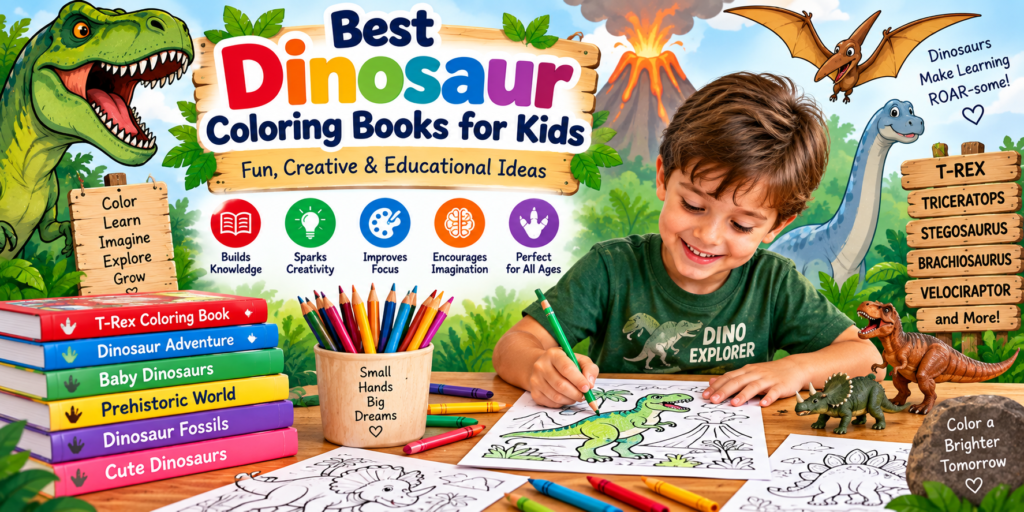
Dinosaurs have fascinated children for generations. From the powerful Tyrannosaurus rex to the three-horned Triceratops and long-necked Brachiosaurus, these prehistoric creatures offer an exciting combination of mystery, adventure, science, and imagination.
That makes dinosaur coloring books an excellent creative activity for children who love prehistoric animals.
A dinosaur coloring book can be enjoyed simply as an art activity, but it can also encourage children to explore dinosaur names, body shapes, habitats, fossils, prehistoric environments, and basic science concepts. Children can color realistic-looking dinosaurs or create their own imaginative versions using any colors they choose.
For parents and teachers, dinosaur coloring books can also provide an easy way to combine creative play with conversations about prehistoric life.
In this guide, we’ll explore the best types of dinosaur coloring books for kids, age-appropriate designs, popular dinosaur themes, educational activity ideas, printable options, and practical tips for choosing the right coloring book.
Quick Answer: What Are the Best Dinosaur Coloring Books for Kids?
The best dinosaur coloring book depends on a child’s age, interests, and coloring experience.
Popular options include:
- T. rex coloring books
- Triceratops coloring books
- Cute dinosaur coloring books
- Baby dinosaur coloring books
- Dinosaur adventure coloring books
- Dinosaur and volcano coloring books
- Prehistoric world coloring books
- Dinosaur fossil coloring books
- Dinosaur alphabet coloring books
- Educational dinosaur coloring books
For toddlers and younger preschoolers, choose simple dinosaur illustrations with large coloring areas. Older children may enjoy detailed dinosaurs, prehistoric landscapes, fossils, and adventure scenes.
Why Do Kids Love Dinosaur Coloring Books?
Dinosaurs are unusual, mysterious, and visually interesting. Many children enjoy learning their names, comparing their sizes, imagining how they moved, and creating stories around them.
A dinosaur coloring book for kids combines these interests with an activity children can control themselves.
While coloring, children can:
- Experiment with colors
- Create imaginary dinosaur worlds
- Recognize different dinosaur shapes
- Practice observation
- Learn new vocabulary
- Create stories
- Explore prehistoric themes
- Enjoy independent creative time
The appeal doesn’t depend on coloring dinosaurs realistically. Children can make a green Stegosaurus, a purple T. rex, or even a rainbow dinosaur.
The freedom to make creative choices is part of what makes the activity enjoyable.
Popular Types of Dinosaur Coloring Books
Not all dinosaur coloring books have the same style. Choosing a theme that matches a child’s interests can make the experience much more engaging.
1. Cute Dinosaur Coloring Books
Cute dinosaur coloring books use friendly-looking dinosaurs, playful expressions, and simple illustrations.
They can be particularly appealing to younger children who may prefer cartoon-style characters over realistic prehistoric creatures.
Common designs include:
- Baby dinosaurs
- Smiling T. rex
- Friendly Triceratops
- Cute Stegosaurus
- Dinosaur families
- Dinosaur friends
These books are often suitable for casual creative play and imaginative storytelling.
2. Dinosaur Adventure Coloring Books
Adventure-themed coloring books place dinosaurs into exciting scenes.
A page might show dinosaurs:
- Exploring a jungle
- Walking through a prehistoric valley
- Near a volcano
- Crossing a river
- Searching for food
- Meeting other dinosaurs
These scenes can encourage children to invent stories while they color.
3. Dinosaur Coloring Books for Learning
Educational dinosaur coloring books combine illustrations with simple information.
Depending on the child’s age, they might introduce:
- Dinosaur names
- Basic dinosaur groups
- Fossils
- Prehistoric environments
- Dinosaur body parts
- Herbivores and carnivores
- Different periods of prehistoric history
The educational content should remain age appropriate and easy to understand.
4. Dinosaur and Fossil Coloring Books
Children interested in paleontology may enjoy coloring books that include both dinosaurs and fossils.
Pages can feature:
- Dinosaur skeletons
- Fossils
- Excavation scenes
- Paleontologists
- Fossil discoveries
- Dinosaur footprints
This type of coloring book can provide a natural introduction to the idea that scientists use fossils to learn about prehistoric life.
5. Baby Dinosaur Coloring Books
Baby dinosaur themes are a popular choice for younger children.
Illustrations can feature hatchlings, dinosaur families, eggs, nests, and playful baby dinosaurs.
These pages are generally more focused on cute characters and imaginative play than detailed scientific information.
Best Dinosaur Coloring Books by Age
Choosing the right level of detail is important.
A coloring book designed for a toddler may not be suitable for an older child, and vice versa.
| Age Group | Recommended Dinosaur Coloring Book | Illustration Style |
|---|---|---|
| Toddlers | Simple dinosaur coloring books | Large shapes, bold outlines |
| Preschoolers | Cute and basic dinosaur books | Simple to moderate detail |
| Ages 5–7 | Dinosaur adventure books | Moderate detail and scenes |
| Ages 8–12 | Detailed dinosaur books | Complex illustrations |
| Teens | Artistic dinosaur coloring books | Detailed and imaginative designs |
These are general guidelines. Children develop different interests and coloring abilities, so the child’s preferences should always be considered.
Dinosaur Coloring Books for Toddlers
Younger children generally benefit from simple illustrations.
Look for:
- Large dinosaurs
- Thick, clear outlines
- Large coloring areas
- Minimal background details
- Familiar dinosaur shapes
- Friendly expressions
A page with one large dinosaur may be easier for a toddler to approach than a complicated prehistoric landscape.
At this stage, don’t worry about whether the child colors within every line.
The purpose is to let them explore the coloring tools and enjoy the pictures.
Dinosaur Coloring Books for Preschoolers
Preschoolers can explore more dinosaur varieties and simple scenes.
Good choices include:
- T. rex
- Triceratops
- Stegosaurus
- Brachiosaurus
- Pterodactyl
- Baby dinosaurs
- Dinosaur families
- Dinosaur habitats
Parents can make the activity interactive by asking simple questions.
For example:
“Which dinosaur are you coloring?”
“How many dinosaurs can you see?”
“What color would you like to use?”
These questions can turn a coloring session into a conversation.
Dinosaur Coloring Books for Older Kids
Older children may enjoy detailed illustrations featuring multiple dinosaurs and prehistoric environments.
Popular themes include:
- Dinosaur battles
- Dinosaur families
- Prehistoric forests
- Volcano landscapes
- Fossil discoveries
- Dinosaur nests
- Dinosaur adventures
- Detailed dinosaur anatomy
Children can also experiment with shading, patterns, backgrounds, and different color combinations.
Popular Dinosaurs to Include in a Coloring Book
A good dinosaur coloring book can introduce children to a variety of dinosaur names.
Tyrannosaurus Rex
The T. rex is one of the most recognizable dinosaurs and a popular coloring-book subject.
Its large head, teeth, short arms, and powerful appearance make it easy for children to recognize.
Triceratops
Triceratops is known for its three horns and large frill.
Its distinctive appearance makes it another favorite for dinosaur-themed activities.
Stegosaurus
The Stegosaurus can be recognized by the large plates along its back and spikes near its tail.
Its unusual body shape gives children plenty of interesting features to color.
Brachiosaurus
The long neck and large body of Brachiosaurus create a very different coloring experience from smaller dinosaurs.
It can also be featured in scenes involving trees and prehistoric landscapes.
Velociraptor
Velociraptor is another popular dinosaur among children who enjoy fast and active prehistoric creatures.
Pterosaurs
Although pterosaurs were flying reptiles rather than dinosaurs, they are often included in dinosaur-themed children’s activities because of their connection to prehistoric life.
Educational Ideas for Dinosaur Coloring Books
A dinosaur coloring book can become a useful starting point for learning without turning the activity into formal homework.
Learn Dinosaur Names
Ask children to identify each dinosaur.
Start with familiar names and gradually introduce less familiar ones.
Compare Dinosaur Sizes
Ask:
“Which dinosaur looks bigger?”
“Which one has the longest neck?”
This can encourage children to observe differences between illustrations.
Explore Herbivores and Carnivores
Older children can learn the basic difference between animals that primarily eat plants and those that primarily eat other animals.
Use simple explanations appropriate for their age.
Talk About Fossils
Explain that fossils provide evidence scientists use to study prehistoric life.
A dinosaur coloring page showing fossils can be a natural starting point for the conversation.
Create a Prehistoric Habitat
After coloring the dinosaur, encourage children to draw:
- Trees
- Plants
- Mountains
- Rivers
- Rocks
- Volcanoes
- Clouds
This turns one coloring page into a larger creative project.
10 Fun Activities to Do With a Dinosaur Coloring Book
Coloring can be combined with other activities to create a more engaging experience.
1. Dinosaur Name Game
Name a dinosaur and ask the child to find it on the page.
2. Count the Dinosaurs
If a page contains multiple dinosaurs, count them together.
3. Create a Dinosaur Story
Ask the child to invent a story about the dinosaurs.
4. Design a Dinosaur Habitat
Draw a prehistoric landscape around the finished dinosaur.
5. Make a Dinosaur Family
Color a group of dinosaurs and give each one a name.
6. Create a Dinosaur Museum
Display completed dinosaur pages together as a small home museum.
7. Draw Dinosaur Footprints
After coloring a dinosaur, draw footprints leading across the page.
8. Make a Dinosaur Fact Page
Older children can write a few simple facts beside their finished artwork.
9. Create a Dinosaur Scene
Combine several coloring pages into one large prehistoric adventure.
10. Invent a New Dinosaur
Ask children to design their own dinosaur with a unique name, body shape, colors, and abilities.
How to Choose the Best Dinosaur Coloring Book
Before choosing a dinosaur coloring book, consider these factors.
Consider the Child’s Age
Younger children generally need larger, simpler illustrations.
Older children may enjoy more detailed pages.
Look at the Dinosaur Variety
If a child already knows several dinosaur names, a book with a broad selection can keep them interested.
Consider the Illustration Style
Some children prefer realistic-looking dinosaurs, while others enjoy cartoon or kawaii-style characters.
Check the Page Complexity
Highly detailed pages can be fun for experienced colorists but may frustrate younger children.
Match the Child’s Interests
A dinosaur lover who enjoys adventure may prefer prehistoric scenes, while a child interested in science may prefer fossils and educational illustrations.
Printable Dinosaur Coloring Books: Why Choose Them?
Printable dinosaur coloring books and coloring pages can be convenient for parents, teachers, and homeschool families.
They can be used for:
- Rainy-day activities
- Preschool projects
- Homeschool lessons
- Classroom activities
- Travel
- Weekend crafts
- Dinosaur-themed parties
- Quiet creative time
Printable pages also make it easy to choose a specific dinosaur.
For example, you might print T. rex pages one day and Triceratops or Stegosaurus pages another day.
This flexibility can be useful when planning activities around a child’s changing interests.
Dinosaur Coloring Books vs. General Animal Coloring Books
Both can be valuable, but they offer different experiences.
| Feature | Dinosaur Coloring Books | General Animal Coloring Books |
|---|---|---|
| Main subject | Prehistoric creatures | Modern animals |
| Science connection | Strong | Moderate to strong |
| Imagination | Very high | High |
| Vocabulary opportunities | High | High |
| Adventure potential | Very high | High |
| Best for dinosaur fans | Excellent | Depends on content |
A dinosaur coloring book is especially useful when a child has a strong interest in prehistoric life.
Tips for Parents and Teachers
Let Children Choose Their Colors
Dinosaurs don’t have to be colored according to a particular color scheme.
Creative freedom makes the activity more enjoyable.
Avoid Turning Coloring Into a Test
Don’t judge children based on how accurately they color.
The goal is creative participation.
Encourage Questions
If a child asks about a dinosaur, use that curiosity as an opportunity to explore the subject further.
Combine Coloring With Reading
A dinosaur coloring session can be paired with a children’s dinosaur book or age-appropriate educational resource.
Display Finished Artwork
Create a dinosaur wall or folder where children can keep their completed pages.
Seeing their artwork collected together can make the activity feel more meaningful.
Frequently Asked Questions
What are the best dinosaur coloring books for kids?
Popular choices include cute dinosaur coloring books, T. rex coloring books, dinosaur adventure books, educational dinosaur books, fossil-themed books, and prehistoric landscape coloring books.
What dinosaur coloring book is best for toddlers?
Choose a book with large, simple dinosaurs, thick outlines, minimal details, and plenty of open space for coloring.
Are dinosaur coloring books educational?
They can be. Dinosaur coloring books can provide opportunities to learn dinosaur names, compare features, discuss fossils, explore prehistoric environments, and build vocabulary.
Are printable dinosaur coloring books useful?
Yes. Printable dinosaur coloring books and pages can be convenient for home activities, homeschooling, classrooms, travel, parties, and themed learning sessions.
What dinosaurs should a children’s coloring book include?
Popular choices include T. rex, Triceratops, Stegosaurus, Brachiosaurus, Velociraptor, and other prehistoric creatures. A mixture of familiar and less familiar dinosaurs can provide variety.
Can dinosaur coloring books be used for learning?
Absolutely. Parents and teachers can use them to introduce dinosaur names, basic science concepts, vocabulary, counting, storytelling, observation, and creative writing.
Conclusion
Dinosaur coloring books for kids combine creativity, imagination, and one of the most exciting subjects in children’s learning: prehistoric life.
Whether a child prefers a friendly baby dinosaur, a powerful T. rex, a horned Triceratops, a long-necked Brachiosaurus, or an entire prehistoric landscape, dinosaur coloring books offer countless ways to explore the theme.
For younger children, choose simple illustrations with large coloring areas. Preschoolers can explore recognizable dinosaur characters and basic scenes, while older children may enjoy detailed prehistoric environments, fossils, and educational themes.
Parents and teachers can also extend the activity beyond coloring by asking questions, learning dinosaur names, discussing fossils, counting objects, creating stories, and designing prehistoric habitats.
Most importantly, let children use their imagination. A dinosaur doesn’t have to look scientifically realistic to be a great piece of children’s artwork.
Explore ColoringBookArt.com for creative coloring books and printable coloring activities featuring dinosaurs, animals, fantasy themes, educational subjects, and many other popular designs for kids, teens, and adults.