Coloring is often seen as a simple fun activity, but it can also give children opportunities to practice several important skills while being creative. From holding a crayon and choosing colors to recognizing shapes and completing a picture, coloring activities can support everyday learning in an enjoyable way.
For young children, a coloring page may be an opportunity to practice hand control and learn about colors. For older children, more detailed coloring activities can encourage creativity, concentration, decision-making, and patience.
The biggest advantage is that coloring does not have to feel like a formal lesson. Children can learn and practice skills while doing something they enjoy.
This guide explains how coloring activities help children learn and develop skills, what parents and teachers can do to make coloring more educational, and how to choose suitable coloring pages for different age groups.
Quick Answer
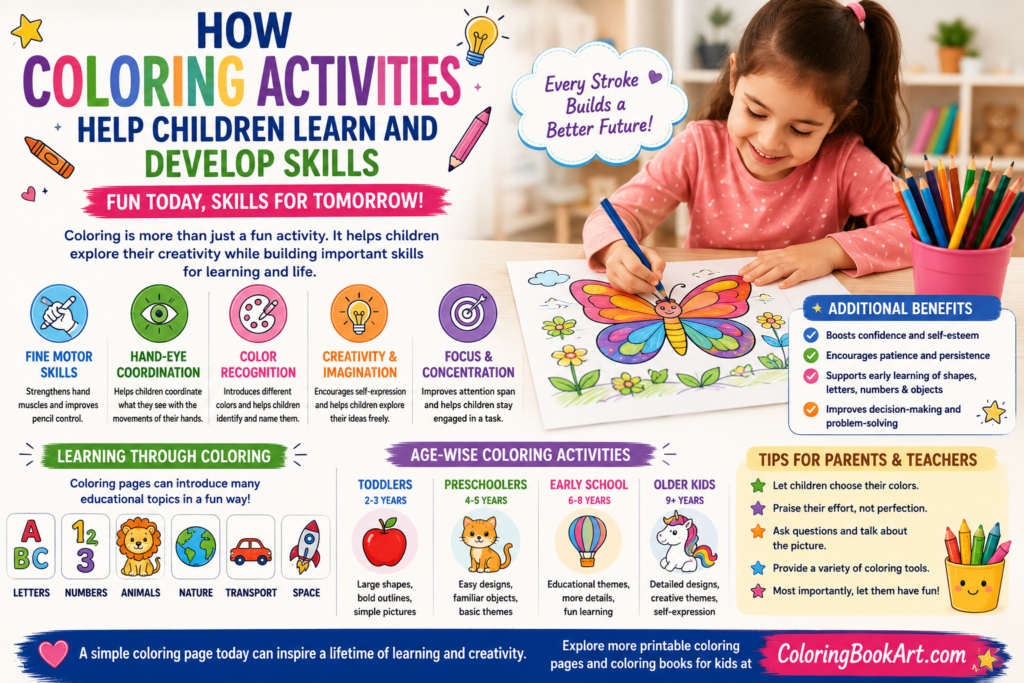
Coloring activities can help children practice fine motor control, hand-eye coordination, color recognition, creativity, focus, and early decision-making skills.
Depending on the activity and the child’s age, coloring can also provide opportunities to practice:
- Recognizing shapes and objects
- Learning about animals, nature, numbers, and letters
- Following simple instructions
- Completing a task
- Expressing creative ideas
- Exploring different colors and combinations
The learning value often depends on choosing age-appropriate coloring pages and allowing children enough freedom to enjoy the activity.
Why Coloring Is More Than Just a Fun Activity
Coloring may look simple, but children often use several skills at the same time.
For example, imagine a child coloring a picture of a lion.
They may need to:
- Hold and control a crayon or colored pencil
- Look at the outlines of the image
- Choose which colors to use
- Move their hand across the page
- Decide where to start
- Continue working until they are finished
The activity combines movement, observation, decision-making, and creativity.
Coloring is also flexible. A simple printable coloring page can be used as a casual creative activity, while an educational coloring worksheet can introduce a specific topic such as animals, numbers, letters, transportation, or nature.
1. Coloring Can Help Develop Fine Motor Skills
One of the most common reasons coloring is included in early childhood activities is that it gives children opportunities to practice controlled hand movements.
Children use their hands and fingers to hold:
- Crayons
- Colored pencils
- Markers
- Other suitable coloring tools
As children color, they practice moving the tool across the page and adjusting their hand movements.
Younger children may make broad strokes and color outside the lines. As they gain more experience and control, they may become more precise.
The goal does not need to be perfect coloring. The activity itself gives children opportunities to practice using their hands in different ways.
Simple Activities for Younger Children
For toddlers and preschool-age children, choose coloring pages with:
- Large pictures
- Thick outlines
- Simple shapes
- Familiar objects
- Large open spaces
Examples include:
- Apples
- Cars
- Cats
- Balls
- Flowers
- Simple animals
Large crayons may also be easier for younger children to hold.
2. Coloring Can Support Hand-Eye Coordination
Coloring requires children to look at an image and coordinate what they see with the movement of their hands.
For example, when a child tries to color inside a large circle, they are watching the boundary while moving the crayon.
This provides practice in coordinating visual information with physical movement.
Simple activities can include:
- Coloring basic shapes
- Coloring around large outlines
- Completing simple pictures
- Matching colors with objects
- Following basic color instructions
As children become more comfortable, they can try more detailed designs.
3. Coloring Helps Children Learn About Colors
Coloring naturally introduces children to different colors.
A child may learn to recognize:
- Red
- Blue
- Yellow
- Green
- Orange
- Purple
- Pink
- Brown
- Black
- White
Parents and teachers can make coloring activities more interactive by asking simple questions.
For example:
- What color is this crayon?
- Can you find the blue pencil?
- Which color would you like to use for the flower?
- What colors do you see in the picture?
Children can also experiment with different color combinations.
A tree does not always need to be green and brown. A child may decide to create a purple tree or a blue cat. This type of creative freedom allows them to make their own choices.
4. Coloring Encourages Creativity and Imagination
One of the most enjoyable parts of coloring is that there is often more than one possible answer.
Two children can receive the same coloring page and create completely different results.
For example, imagine a printable coloring page featuring a fantasy castle.
One child may choose:
- A blue sky
- Green trees
- A gray castle
Another may choose:
- A purple sky
- Pink trees
- A golden castle
Both approaches can reflect different creative choices.
Coloring gives children a prepared image while still allowing them to make decisions about how the final picture should look.
This can make coloring a useful activity for children who enjoy creativity but may not yet feel comfortable drawing a complete picture from a blank page.
5. Coloring Can Help Children Practice Focus
Completing a coloring page usually requires children to spend some time with one activity.
A simple page may only take a few minutes, while a more detailed picture may take longer.
Children can choose:
- Which part to color first
- Which colors to use
- How much time they want to spend
- Whether they want to complete the page in one session
For younger children, short coloring sessions may be more suitable. Older children may enjoy working on detailed pages for longer periods.
Parents and teachers should not expect every child to sit for the same amount of time. The best approach is usually to choose activities that match the child’s age and interests.
6. Coloring Can Introduce Educational Topics
Coloring pages can be used to introduce many different subjects.
This is where educational coloring books and printable coloring pages can become especially useful.
Alphabet Coloring Pages
Children can color letters while becoming familiar with the alphabet.
For example:
- A for Apple
- B for Ball
- C for Cat
A page can combine a letter with a familiar object.
Number Coloring Pages
Children can color numbers while practicing number recognition.
A simple activity could include:
- Coloring the number
- Counting objects
- Matching a number with a group of items
Animal Coloring Pages
Animal-themed coloring pages can introduce children to:
- Different animals
- Habitats
- Animal names
- Farm animals
- Wild animals
- Sea creatures
Nature Coloring Pages
Nature-themed pages can include:
- Trees
- Flowers
- Leaves
- Mountains
- Birds
- Butterflies
Parents and teachers can use the coloring activity as a starting point for conversation.
For example:
“What kind of animal is this?”
“Where do you think it lives?”
“What colors do you see in nature?”
7. Coloring Can Help Children Practice Decision-Making
Even a simple coloring activity involves choices.
Children may decide:
- Which page to color
- Which color to choose
- Where to begin
- Which parts should be darker
- Whether to use realistic or imaginary colors
These may seem like small decisions, but they allow children to participate actively in the creative process.
Parents can encourage independent choices by avoiding the need to correct every color selection.
For example, if a child wants to color a dog purple, there is usually no need to say that the color is wrong.
Instead, you can ask:
“Why did you choose purple?”
This can encourage children to explain their ideas and think creatively.
8. Coloring Can Encourage Patience and Task Completion
Some children enjoy finishing a coloring page from beginning to end.
Others may prefer to complete one section and return later.
Both approaches can be part of the learning process.
Completing a page can give children a sense of accomplishment.
Parents and teachers can encourage children without creating unnecessary pressure.
Instead of saying:
“You have to finish the whole page.”
Try:
“Would you like to finish this part today?”
Breaking a large activity into smaller sections can make detailed coloring pages feel more manageable.
9. Coloring Can Support Early Shape Recognition
Many coloring pages contain simple shapes and patterns.
Young children can begin recognizing:
- Circles
- Squares
- Triangles
- Stars
- Hearts
Parents can turn a coloring page into a simple learning activity by asking children to identify shapes before or during coloring.
For example:
“Can you find three circles?”
“Which shape looks like a triangle?”
This combines creative play with basic observation.
10. Coloring Can Help Children Explore Themes They Enjoy
Children are often more interested in activities related to their favorite subjects.
Popular coloring book themes for children include:
- Animals
- Dinosaurs
- Princesses
- Vehicles
- Fantasy characters
- Space
- Nature
- Superheroes
- Farm animals
- Underwater creatures
Choosing a theme that matches a child’s interests can make coloring feel more exciting.
For example, a child who loves dinosaurs may be more interested in learning about different dinosaur names while coloring dinosaur pages.
A child who enjoys animals may enjoy talking about where different animals live.
This makes the activity more personal and engaging.
Coloring Activities by Age Group
The best coloring activities can vary depending on age and ability.
| Age Group | Suitable Coloring Activities | Helpful Features |
|---|---|---|
| Toddlers | Simple pictures and shapes | Large spaces and thick outlines |
| Preschoolers | Animals, letters and familiar objects | Bright colors and simple designs |
| Early school-age children | Educational and themed pages | More details and learning topics |
| Older kids | Fantasy, animals and creative scenes | Smaller details and more choices |
| Teens | Detailed illustrations and creative themes | Complex designs and personal expression |
These are general suggestions rather than strict rules.
Some younger children may enjoy detailed pages, while some older children may prefer simple designs.
How Parents Can Make Coloring More Educational
Coloring does not need to become a formal lesson.
Simple conversations can make the activity more interactive.
Ask Open-Ended Questions
Instead of asking only questions with one correct answer, try questions such as:
- What is happening in this picture?
- What colors would you like to use?
- Can you create a story about this character?
- Where do you think this animal lives?
Introduce New Words
A coloring page can introduce vocabulary.
For example, a nature coloring page may include words such as:
- Petal
- Leaf
- Stem
- Forest
- Mountain
An animal page can introduce names and categories.
Create Simple Challenges
You can add small activities such as:
- Find three different animals.
- Use two shades of blue.
- Color all circles yellow.
- Count the objects in the picture.
The activity should remain enjoyable rather than feeling like a difficult test.
Coloring Activities for the Classroom
Teachers can use coloring pages in many different ways.
For example:
Topic Introductions
A coloring activity can introduce a new subject.
Examples include:
- Animals
- Seasons
- Space
- Transportation
- Plants
Seasonal Activities
Seasonal printable coloring pages can be useful for:
- Christmas
- Halloween
- Easter
- Thanksgiving
- Spring activities
- Summer activities
Early Learning Worksheets
Coloring can be combined with:
- Letters
- Numbers
- Shapes
- Simple words
- Matching activities
Printable coloring pages can make it easier to prepare different activities for a class or group.
Printable Coloring Pages vs. Physical Coloring Books for Learning
Both can be useful.
Printable Coloring Pages
Printable pages allow parents and teachers to select individual activities based on a specific topic.
For example, you can print:
- One alphabet page
- One animal page
- One number activity
This can be useful when planning a focused activity.
Physical Coloring Books
Physical coloring books provide a ready-made collection of designs.
Children can turn pages and choose what they want to color.
Both options can support creative and educational activities depending on how they are used.
Common Mistakes to Avoid
Expecting Perfect Results
Coloring is not a competition.
Young children are still learning how to control their movements.
Choosing Pages That Are Too Difficult
Very detailed pages can frustrate younger children.
Start with simple designs and increase complexity gradually.
Correcting Every Color Choice
Creative coloring does not always need realistic colors.
Allow children to make their own choices.
Giving Too Many Instructions
Some guidance can be useful, but children should also have time to explore independently.
Focusing Only on the Finished Page
The process of coloring can be just as important as the final picture.
Frequently Asked Questions
How does coloring help children learn?
Coloring gives children opportunities to practice hand control, color recognition, creativity, observation, and decision-making. Educational coloring pages can also introduce topics such as letters, numbers, animals, and nature.
What skills can children practice through coloring?
Children may practice fine motor control, hand-eye coordination, color recognition, creativity, concentration, and basic decision-making while coloring.
Are coloring activities good for toddlers?
Simple coloring activities with large shapes, thick outlines, and easy-to-hold crayons can be suitable for toddlers. Activities should be appropriate for the child’s age and supervised when necessary.
Can coloring pages be educational?
Yes. Coloring pages can be combined with educational topics such as the alphabet, numbers, animals, nature, shapes, and seasonal themes.
How do I choose the right coloring pages for my child?
Consider the child’s age, interests, and comfort level. Younger children may prefer large and simple designs, while older children may enjoy more detailed themes.
Should children stay inside the lines when coloring?
Staying inside the lines can be something children practice as their hand control develops, but it should not be the only goal. Younger children may naturally color outside the lines while learning.
Conclusion
Coloring activities can help children learn and develop skills while giving them an enjoyable way to explore creativity.
From practicing hand control and recognizing colors to making creative decisions and exploring educational topics, coloring can be adapted for different ages and interests.
The best coloring activities are usually simple, engaging, and appropriate for the child’s current level. Toddlers may enjoy large shapes and bold outlines, while older children may prefer animals, fantasy worlds, educational activities, and more detailed creative designs.
Parents and teachers can also use coloring as an opportunity for conversation. A simple printable coloring page can become a fun activity about animals, numbers, letters, nature, or imagination.
Most importantly, children should have the freedom to enjoy the creative process.
Explore ColoringBookArt.com for printable coloring pages, coloring books for kids, educational themes, animal designs, fantasy coloring activities, and creative pages for children of different ages.