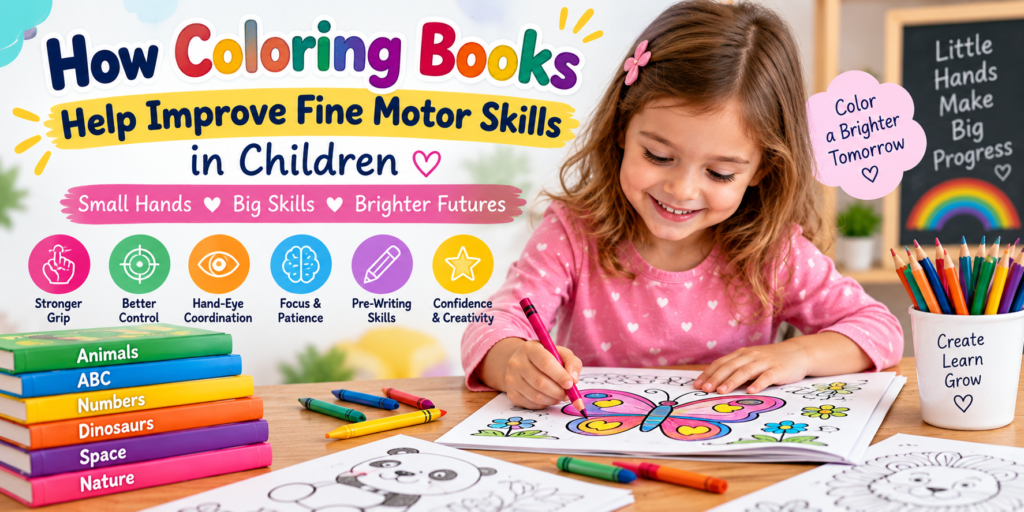
Coloring books are often seen as a simple creative activity for children, but they can also provide opportunities to practice important hand and finger movements. When children pick up a crayon, hold a colored pencil, stay within an outline, or choose where to add color, they are practicing physical skills that support everyday activities.
One area parents and educators often focus on is fine motor skills. These are the small, controlled movements of the hands, fingers, and wrists that children use for activities such as drawing, writing, buttoning clothes, using scissors, and handling small objects.
For this reason, coloring books for kids can be a useful addition to a child’s collection of creative activities. They provide repeated opportunities to practice controlled movements while keeping the experience enjoyable.
In this guide, we’ll explore how coloring books can support fine motor practice, which coloring activities are appropriate for different ages, how to choose the right coloring book, and practical ways parents can make coloring time more engaging.
Quick Answer: Do Coloring Books Help Fine Motor Skills?
Yes. Coloring books can provide children with opportunities to practice fine motor movements, including gripping coloring tools, moving the hand with control, adjusting pressure, and coordinating hand and eye movements.
The benefits depend on the child’s age, the type of coloring activity, and how the activity is approached. Coloring should not be treated as a replacement for other forms of play or skill development. Instead, it can be one enjoyable activity among many that encourage children to use their hands and fingers.
What Are Fine Motor Skills?
Fine motor skills involve small movements that require coordination between the hands, fingers, and eyes.
Children use these skills throughout the day.
Examples include:
- Holding a pencil or crayon
- Turning pages in a book
- Picking up small objects
- Using a spoon
- Building with blocks
- Using scissors
- Drawing pictures
- Writing letters and numbers
- Buttoning clothing
- Opening containers
- Using simple classroom tools
Developing these skills is a gradual process. Young children typically begin with simpler hand movements and gradually gain more control and precision as they grow.
Creative activities such as drawing, painting, playdough, puzzles, and coloring can provide different opportunities for children to practice these movements.
How Coloring Books Support Fine Motor Development
1. Holding Crayons and Pencils Builds Hand Control
Before children become comfortable writing with a pencil, they need opportunities to use their hands and fingers in controlled ways.
Coloring gives them a reason to repeatedly pick up and manipulate a tool.
A child may use:
- Crayons
- Colored pencils
- Washable markers
- Chunky pencils
- Paint sticks
- Other age-appropriate coloring tools
Different tools provide different experiences.
For younger children, larger crayons may be easier to hold. As children become more comfortable with coloring, they can experiment with thinner pencils or other tools that require greater precision.
The important part is giving children opportunities to use their hands naturally while creating something they enjoy.
2. Coloring Encourages Controlled Hand Movements
A blank sheet of paper allows children to make marks anywhere.
A coloring book introduces boundaries.
When a child tries to color inside an illustration, they need to move their hand in a more controlled way.
For example, coloring a small section of a butterfly requires different control than making large strokes across an entire sheet.
Over time, children can experiment with:
- Short strokes
- Long strokes
- Circular movements
- Back-and-forth movements
- Small details
- Larger areas
These simple variations make coloring a flexible creative activity.
3. Coloring Supports Hand-Eye Coordination
Coloring involves looking at an image while simultaneously controlling the movement of the hand.
This is an example of hand-eye coordination.
A child might look at the edge of a shape and adjust the coloring tool to stay near the outline.
They may also move their hand toward a particular part of the page after deciding where they want to add color.
This combination of visual attention and hand movement makes coloring a useful activity for practicing coordination.
4. Coloring Provides Repetition
Children often improve skills through repeated practice.
One of the advantages of coloring books is that children can repeat similar movements without having to repeat exactly the same activity.
For example, a child could color:
- A flower
- A butterfly
- A tree
- A house
- An animal
- A car
The pictures are different, but the child continues practicing basic hand movements.
Because coloring is enjoyable, children may naturally spend more time practicing than they would with an activity presented purely as an exercise.
Coloring Books by Age
Not every coloring book is appropriate for every child. The best choice depends on the child’s age, experience, interests, and comfort level.
Coloring Books for Toddlers
Toddlers generally benefit from simple illustrations with large areas to color.
Look for:
- Large pictures
- Simple outlines
- Familiar objects
- Minimal details
- Plenty of open space
Popular themes include animals, toys, vehicles, fruits, shapes, and everyday objects.
At this stage, the objective should be exploration rather than perfect coloring.
A toddler may color outside the lines, switch colors frequently, or make large marks across the page. That’s completely normal for a creative activity.
Coloring Books for Preschoolers
Preschool children can begin experimenting with more structured coloring activities.
Good themes include:
- ABC coloring books
- Number coloring books
- Animal coloring books
- Dinosaur coloring books
- Nature coloring books
- Shape coloring books
- Transportation coloring books
Illustrations can contain somewhat more detail while still providing reasonably large areas to color.
Parents can also encourage children to identify objects, colors, letters, or numbers as they work.
Coloring Books for Kindergarten and Early Elementary Children
Older children can generally explore more detailed illustrations.
Consider:
- Fantasy coloring books
- Space coloring books
- Science coloring books
- Detailed animal coloring books
- Nature scenes
- Vehicles
- Adventure themes
- Educational coloring books
More detailed illustrations can give children additional opportunities to practice controlled coloring and attention to smaller areas.
However, complexity should still match the individual child’s interests and ability.
Simple Coloring Activities for Fine Motor Practice
A coloring book doesn’t have to be used in only one way.
Try these activities to make coloring sessions more varied.
1. Color Inside the Shapes
Choose pages with recognizable shapes and encourage children to explore coloring within each area.
Don’t turn it into a test. The goal is simply to give them an opportunity to practice controlled movements.
2. Use Different Stroke Patterns
Ask children to experiment with:
- Horizontal lines
- Vertical lines
- Zigzags
- Circles
- Dots
- Short strokes
This can make a simple coloring page more interesting.
3. Try Different Coloring Tools
Depending on the child’s age and the materials available, introduce different tools.
For example:
| Coloring Tool | Coloring Experience |
|---|---|
| Chunky crayons | Easier for younger children to grip |
| Standard crayons | Good for general coloring |
| Colored pencils | Useful for detailed areas |
| Washable markers | Smooth, bold coloring |
| Paint sticks | Different tactile and visual experience |
Always choose materials that are appropriate for the child’s age and supervise young children when necessary.
4. Color Small Sections
For children who are ready for more detailed activities, choose coloring books with smaller sections.
A picture containing flowers, leaves, patterns, or other details can encourage more precise movements.
5. Trace and Color
Some coloring books contain simple shapes, letters, or objects that can be traced before coloring.
This creates a two-step activity:
Trace → Color
It can make the coloring session more varied while encouraging children to pay attention to lines and shapes.
Coloring Books and Pre-Writing Skills
Coloring is not the same as handwriting, but it can be part of a broader collection of activities that involve controlled hand movements.
Children can use coloring activities alongside:
- Drawing
- Tracing
- Cutting with child-safe scissors
- Connecting dots
- Puzzles
- Building blocks
- Playdough
- Simple crafts
For example, a child could color an apple, trace the word “apple,” and then draw their own apple.
The activities are different, but they all encourage children to interact with materials using their hands.
How Parents Can Make Coloring More Engaging
The best coloring activity doesn’t have to be complicated.
Let Children Choose the Coloring Book
Allowing children to select a subject they enjoy can make them more interested in the activity.
A child who loves dinosaurs may be much more excited about a dinosaur coloring book than a generic workbook.
Don’t Focus on Staying Inside the Lines
For young children especially, coloring outside the lines is part of learning and exploration.
Instead of constantly correcting them, focus on the creative process.
Encourage Different Colors
Let children make their own choices.
A purple elephant or green dinosaur can be perfectly acceptable in a creative coloring activity.
Display Finished Artwork
Putting completed coloring pages on a refrigerator, wall, classroom board, or personal art folder can give children a sense of accomplishment.
Keep Sessions Enjoyable
There is no need to force a child to continue coloring when they are no longer interested.
Short, enjoyable sessions can be more positive than turning coloring into a chore.
How to Choose the Right Coloring Book
When selecting a coloring book for fine motor practice, consider these factors.
Illustration Size
Younger children usually need larger areas, while older children may enjoy more detailed illustrations.
Line Thickness
Clear, easy-to-see outlines can make pages easier for young children to follow.
Theme
Choose subjects that match the child’s interests.
Difficulty
Avoid choosing a book solely because it contains highly detailed artwork. More detail doesn’t automatically mean a better coloring experience.
Variety
A book containing different types of illustrations can keep children interested and provide opportunities to practice different movements.
Coloring Books vs. Other Fine Motor Activities
Coloring is only one way to encourage children to use their hands.
| Activity | Main Experience | Creative Element |
|---|---|---|
| Coloring books | Controlled coloring and hand movements | High |
| Drawing | Free-form hand control | Very high |
| Playdough | Manipulating and shaping material | High |
| Puzzles | Picking up and positioning pieces | Medium |
| Building blocks | Gripping and assembling objects | High |
| Cutting crafts | Controlled cutting movements | High |
| Beading activities | Handling small objects | High |
A balanced collection of activities can provide children with different ways to practice hand and finger movements.
Common Mistakes Parents Should Avoid
Making Coloring Competitive
Coloring doesn’t need to become a competition over who finishes first or stays inside the lines best.
Choosing Age-Inappropriate Pages
Very detailed pages may frustrate younger children, while extremely simple pages may not interest older kids.
Correcting Every Color Choice
Children don’t need to reproduce realistic colors. Creativity is part of the experience.
Treating Coloring as a Test
A coloring session should be enjoyable. Avoid making children feel that they are being graded on their artwork.
Ignoring the Child’s Interests
A subject that excites a child can make the entire activity more engaging.
Frequently Asked Questions
Can coloring books improve fine motor skills?
Coloring books can provide opportunities for children to practice controlled hand and finger movements, grip, visual attention, and hand-eye coordination. They work best as one part of a broader range of age-appropriate activities.
What type of coloring book is best for toddlers?
Choose coloring books with large, simple illustrations, clear outlines, familiar subjects, and plenty of open space. Animal, vehicle, food, and basic shape themes can be good options.
Are detailed coloring books good for children?
Detailed coloring books can be appropriate for older children who enjoy more challenging artwork. For younger children, simpler illustrations are generally easier to manage.
Does coloring help with handwriting?
Coloring is not handwriting practice by itself, but it gives children opportunities to practice controlled hand movements. Drawing, tracing, cutting, and other activities can complement coloring as children develop pre-writing abilities.
What coloring tools are best for young children?
For younger children, larger crayons and other easy-to-grip, age-appropriate coloring tools can be convenient. As children become more experienced, they can explore colored pencils and other tools for more detailed artwork.
How can I make coloring more educational?
Combine coloring with conversation and simple activities. Ask children to identify objects, count items, name colors, describe pictures, or create stories about the illustrations.
Conclusion
Coloring books for kids can be much more than a source of entertainment. They provide children with an enjoyable opportunity to practice hand movements, explore colors, coordinate what they see with what they do, and develop greater control while creating artwork.
The most important factor is choosing an appropriate coloring book for the child’s age and interests. Toddlers may enjoy large, simple illustrations, while preschoolers can explore ABCs, numbers, animals, and shapes. Older children can move toward detailed fantasy, nature, science, dinosaur, space, and other creative themes.
Remember that coloring is only one of many activities that can support children’s development. Combine coloring with drawing, puzzles, building, crafts, playdough, and other hands-on activities for variety.
Whether you’re looking for an educational coloring book, an animal-themed activity, a printable coloring book, or a creative book based on a child’s favorite subject, the right design can make creative time more engaging.
Explore ColoringBookArt.com to discover a growing selection of coloring books and printable coloring activities for kids, teens, and adults—and find a creative theme that makes every coloring session more enjoyable.