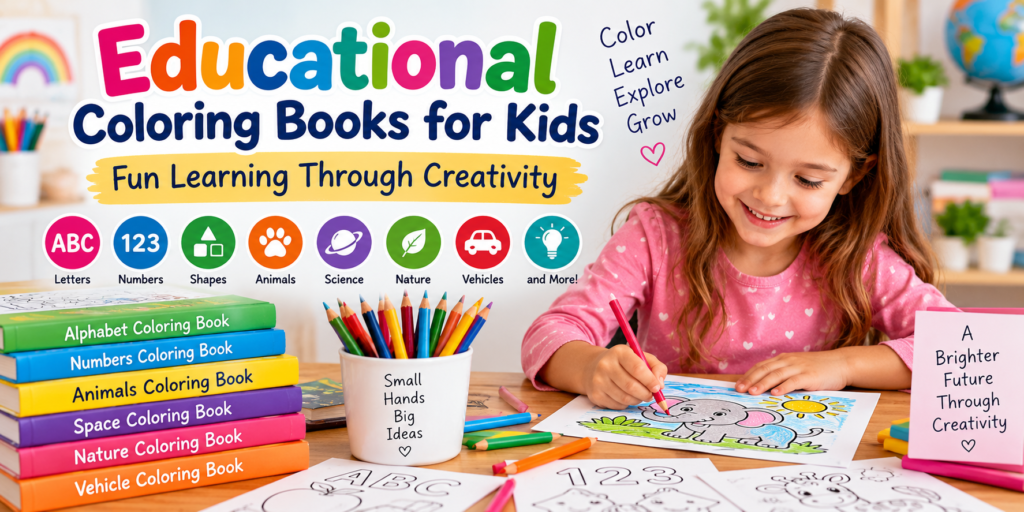
Coloring books are more than a fun way to keep children busy. The right educational coloring book can combine creativity with early learning, helping children explore subjects such as letters, numbers, animals, nature, shapes, transportation, and the world around them.
For parents and teachers, coloring books can be especially useful because they make learning more hands-on and enjoyable. Instead of simply looking at information, children can interact with a subject by coloring, identifying objects, recognizing patterns, and discussing what they see.
But not every coloring book is equally educational. Some are designed primarily for entertainment, while others are created around specific learning goals.
In this guide, we’ll explain what makes an educational coloring book effective, how to choose one by age and learning objective, and how parents can turn ordinary coloring time into a meaningful learning activity.
Quick Answer: What Is an Educational Coloring Book?
An educational coloring book is a coloring book designed to combine creative coloring with learning.
Depending on the theme and age group, an educational coloring book may help children explore:
- Alphabet and letter recognition
- Numbers and counting
- Colors and shapes
- Animals and wildlife
- Nature and the environment
- Science concepts
- Vehicles and transportation
- Space and planets
- Community helpers
- Vocabulary and language
- Problem-solving and observation
The best educational coloring books don’t make children feel like they are doing extra schoolwork. Instead, they turn learning into an enjoyable creative activity.
Why Are Educational Coloring Books Popular?
Children naturally learn through exploration and repetition. Coloring provides an opportunity to repeat concepts without making the activity feel repetitive.
For example, a child learning about animals might color a lion, elephant, giraffe, and zebra. A parent can then ask questions about each animal, turning a simple coloring page into a conversation about habitats, food, sounds, and animal behavior.
Similarly, an alphabet coloring book can introduce a letter alongside an object that begins with that letter.
This makes coloring a useful complement to other learning activities.
What Makes a Coloring Book Educational?
Simply adding words or numbers to a coloring page doesn’t automatically make it educational.
A well-designed educational coloring book should connect its illustrations with an understandable learning objective.
1. A Clear Learning Theme
The coloring book should have a recognizable subject.
Examples include:
- ABC coloring books
- Number coloring books
- Animal coloring books
- Dinosaur coloring books
- Space coloring books
- Nature coloring books
- Vehicle coloring books
- Science coloring books
A clear theme helps children focus on a particular subject while enjoying the creative activity.
2. Age-Appropriate Designs
A coloring book for a toddler should not have the same complexity as one designed for an eight-year-old.
Younger children generally benefit from:
- Large illustrations
- Simple shapes
- Thick outlines
- Fewer details
- Familiar objects
Older children can handle:
- More detailed illustrations
- Smaller sections
- Complex scenes
- Multiple objects
- Subject-specific information
Choosing the right complexity can make coloring more enjoyable and less frustrating.
3. Opportunities for Conversation
One of the biggest advantages of educational coloring books is that they can encourage interaction between children and adults.
A page featuring a farm, for example, can lead to questions such as:
“Which animals can you see?”
“What does a cow eat?”
“Where does a farmer grow vegetables?”
The coloring page becomes the starting point for a broader learning experience.
Best Types of Educational Coloring Books for Kids
Different educational coloring books are useful for different ages and interests.
| Coloring Book Type | What Children Can Explore | Best For |
|---|---|---|
| ABC Coloring Book | Letters and vocabulary | Preschoolers |
| Number Coloring Book | Numbers and counting | Preschool & early learners |
| Shape Coloring Book | Basic shapes | Toddlers & preschoolers |
| Animal Coloring Book | Animals and habitats | Young children |
| Dinosaur Coloring Book | Prehistoric animals | Kids interested in dinosaurs |
| Space Coloring Book | Planets and astronomy | Curious older kids |
| Nature Coloring Book | Plants, flowers, environment | Kids interested in nature |
| Vehicle Coloring Book | Cars, trucks, planes, trains | Vehicle-loving children |
| Science Coloring Book | Basic science concepts | Elementary-age children |
The best choice depends on the child’s age, interests, and current learning goals.
Educational Coloring Books by Age
Educational Coloring Books for Toddlers
For toddlers, simplicity is important.
Choose coloring books featuring large, recognizable illustrations such as:
- Apples
- Balloons
- Cars
- Dogs
- Cats
- Flowers
- Simple shapes
- Basic objects
At this stage, the objective isn’t necessarily to teach detailed facts. Instead, coloring can introduce children to objects, vocabulary, shapes, and visual recognition.
Parents can point to an illustration and name it while the child colors.
For example:
“This is a red apple. Can you color the apple?”
This combines vocabulary, recognition, and creative play.
Educational Coloring Books for Preschoolers
Preschoolers can begin exploring more structured educational themes.
Good options include:
- Alphabet coloring books
- Number coloring books
- Animal coloring books
- Shape coloring books
- Transportation coloring books
- Nature coloring books
At this age, parents can introduce simple questions alongside the coloring activity.
If a child is coloring a butterfly, for example, you could talk about wings, colors, flowers, and where butterflies live.
Educational Coloring Books for Kindergarten and Early Elementary Kids
Older children can handle more detailed educational coloring books.
Consider themes such as:
- Dinosaurs
- Space
- Oceans
- Geography
- Science
- Nature
- Famous landmarks
- Inventions
- Transportation
These books can combine creativity with age-appropriate facts and vocabulary.
How to Choose the Right Educational Coloring Book
Choosing the right book doesn’t have to be complicated.
Consider these five factors.
1. Consider the Child’s Age
Always start with age appropriateness.
A book that is too simple may become boring, while a book that is too detailed can be frustrating for a younger child.
2. Follow the Child’s Interests
Children are more likely to engage with subjects they already enjoy.
If a child loves dinosaurs, a dinosaur coloring book may encourage more engagement than a generic educational book.
If they love space, choose planets, rockets, astronauts, and astronomy themes.
Interest can be a powerful starting point for learning.
3. Look at the Illustration Style
Check whether the illustrations are easy to understand.
For younger children, look for clear images with sufficient space for coloring.
For older children, more detailed illustrations can provide an additional challenge.
4. Check the Learning Objective
Ask what you want the child to learn.
For example:
- Learning letters → ABC coloring book
- Learning numbers → Number coloring book
- Exploring animals → Animal coloring book
- Learning about nature → Nature coloring book
- Exploring science → Science-themed coloring book
A specific goal makes it easier to choose a useful book.
5. Choose a Format That Fits Your Needs
Educational coloring books are available in both physical and printable formats.
Printable coloring books can be particularly convenient when parents want immediate access to an activity at home.
Physical books, meanwhile, provide a ready-to-use collection that children can keep and revisit.
Educational Coloring Books vs. Regular Coloring Books
The difference isn’t always about whether one is “better.”
A regular coloring book may focus primarily on creativity, relaxation, characters, or entertainment.
An educational coloring book adds a learning component.
| Feature | Regular Coloring Book | Educational Coloring Book |
|---|---|---|
| Main purpose | Creativity & entertainment | Creativity + learning |
| Subject matter | Broad | Usually focused |
| Learning objective | Optional | Usually intentional |
| Suitable for free play | Yes | Yes |
| Parent interaction | Optional | Often useful |
| Educational discussions | Less structured | More opportunities |
Both types have value. In fact, children can benefit from having both creative and educational coloring experiences.
7 Ways to Make an Educational Coloring Book More Interactive
You don’t have to stop when the child finishes coloring.
Try these activities.
1. Ask Questions
Talk about what appears on the page.
Ask:
- What is this?
- Where does it live?
- What does it eat?
- What color should it be?
- Have you seen one before?
2. Practice New Words
Introduce vocabulary related to the picture.
For an ocean coloring page, words might include:
ocean, dolphin, coral, fish, whale, shell
3. Count Objects
If a page contains multiple objects, ask the child to count them.
For example:
“How many stars are on the page?”
4. Identify Colors
Ask children to choose colors intentionally.
You can also introduce color combinations and basic color concepts.
5. Encourage Storytelling
A detailed coloring page can become the starting point for a story.
If the page shows a castle, ask the child to imagine who lives there and what happens inside.
6. Connect the Page to Real Life
An animal coloring page can lead to a visit to a zoo.
A plant coloring page can lead to gardening.
A space coloring page can lead to looking at the moon or learning about planets.
7. Let Children Make Their Own Choices
Educational doesn’t mean every activity needs strict instructions.
Allow children to experiment with colors, patterns, and ideas.
Creativity is part of the learning process too.
Printable Educational Coloring Books: Are They Worth Using?
Printable educational coloring books can be a convenient option for families, teachers, and homeschool activities.
They allow adults to print pages when needed and select themes that match a child’s current interests or learning activities.
They can also be useful for:
- Rainy-day activities
- Classroom activities
- Homeschooling
- Travel activities
- Quiet time
- Weekend projects
- Holiday learning
- Creative play
For parents who already have access to a printer, printable coloring pages can provide a flexible way to introduce new activities without needing to purchase a new physical book every time.
Common Mistakes When Choosing Educational Coloring Books
Avoid choosing a book simply because it has the word “educational” in its title.
Instead, look at the actual content.
Common mistakes include:
Choosing a Book That’s Too Difficult
Detailed pages aren’t necessarily better. The child should be able to participate comfortably.
Ignoring Interests
A theoretically useful book may remain untouched if the subject doesn’t interest the child.
Focusing Only on Academic Skills
Learning isn’t limited to letters and numbers. Creativity, observation, vocabulary, curiosity, and communication can also be valuable outcomes of a coloring activity.
Making Coloring Feel Like Homework
The goal should be to create an enjoyable learning experience.
Let children experiment and enjoy the process.
How ColoringBookArt.com Can Help
ColoringBookArt.com provides a variety of coloring resources designed around different interests, ages, and themes.
Whether you’re looking for coloring books for kids, printable coloring pages, animal themes, fantasy designs, educational concepts, or creative activities, choosing a subject that matches a child’s interests can make coloring time more engaging.
Parents can also combine different types of coloring books as children grow—from simple designs for younger children to more detailed themes for older kids and eventually creative coloring books for teens and adults.
Frequently Asked Questions
What is the best educational coloring book for kids?
The best educational coloring book depends on the child’s age, interests, and learning goals. ABC, numbers, animals, shapes, nature, science, and space are popular educational themes.
Are coloring books good for preschool learning?
Yes. Coloring books can complement preschool learning by providing opportunities to explore letters, numbers, colors, shapes, vocabulary, and different subjects through creative activities.
What should I look for in an educational coloring book?
Look for age-appropriate illustrations, a clear theme, suitable complexity, engaging subjects, and a meaningful connection between the coloring activity and the learning objective.
Are printable educational coloring books useful?
Yes. Printable coloring books and pages can be convenient for home learning, classrooms, homeschooling, travel, rainy days, and other creative activities.
Can animal coloring books be educational?
Absolutely. Animal coloring books can introduce children to animal names, habitats, body features, food, behavior, and basic wildlife concepts while they color.
How can parents make coloring books educational?
Parents can ask questions, introduce vocabulary, count objects, discuss colors, encourage storytelling, and connect the illustrations with real-world experiences.
Conclusion
An educational coloring book can turn an ordinary creative activity into an opportunity for exploration and learning. The key is choosing a book that matches the child’s age, interests, abilities, and learning goals.
For younger children, simple ABC, number, shape, and animal coloring books can introduce basic concepts. As children grow, more detailed themes such as dinosaurs, space, science, nature, and transportation can provide new opportunities to explore the world.
Most importantly, don’t worry about making every coloring session perfectly educational. Coloring should remain fun. When children enjoy what they are doing, learning can happen naturally through questions, conversations, observation, imagination, and creativity.
Explore ColoringBookArt.com to discover coloring books and printable coloring activities for kids, teens, and adults—and find a creative theme that makes learning and coloring more enjoyable.