Coloring is one of those simple activities that can be enjoyed at almost any age. Give a child a box of crayons and a coloring page, and they’ll probably start creating immediately. Give an adult a detailed floral, mandala, or fantasy design, and the same simple activity can become a relaxing creative hobby.
But coloring isn’t only about filling spaces with different colors. It can encourage creativity, self-expression, concentration, and imagination while providing an enjoyable break from screens and busy routines.
Whether you’re choosing coloring pages for children or looking for a new hobby for yourself, there are plenty of reasons to make coloring part of your creative routine.
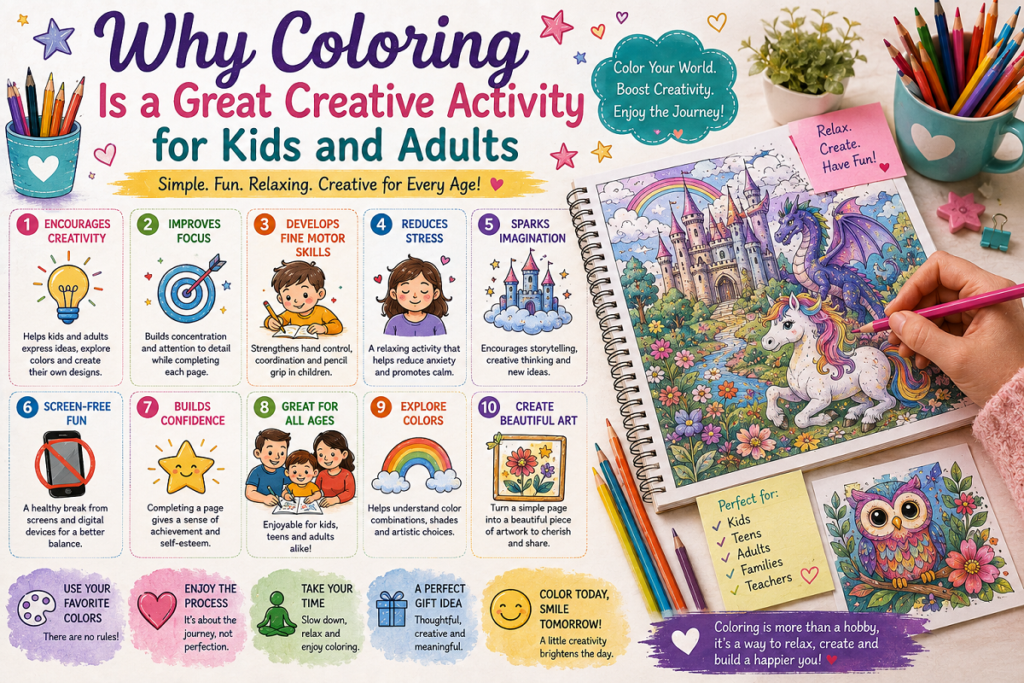
Quick Answer: What Are the Benefits of Coloring?
Coloring can provide several creative and practical benefits for both children and adults.
It can help people:
- Express creativity
- Practice fine motor skills
- Improve concentration
- Explore colors and patterns
- Develop imagination
- Enjoy screen-free time
- Create finished artwork
- Spend quality time with family
- Develop an enjoyable creative hobby
The experience can be different for everyone. A young child may use coloring to explore colors, while an adult may enjoy it as a quiet creative activity.
1. Coloring Encourages Creativity
One of the biggest advantages of coloring is the freedom to make choices.
There isn’t always one correct color for an illustration.
A child can color a dinosaur green, blue, or rainbow-colored. An adult can turn a realistic flower into a completely imaginative design.
Coloring encourages questions such as:
Which colors should I use?
What happens if I combine these colors?
How can I make this picture look different?
These small decisions give people an opportunity to experiment creatively.
2. Coloring Supports Fine Motor Skills in Children
Young children are still developing the hand and finger control needed for writing, drawing, and other everyday activities.
Holding crayons and colored pencils, moving them across a page, and attempting to color within outlines all involve controlled hand movements.
Simple coloring activities can therefore provide opportunities to practice:
- Grip
- Hand control
- Eye-hand coordination
- Precise movements
- Drawing movements
For younger children, choose coloring pages with large illustrations and thick outlines rather than highly detailed designs.
3. Coloring Can Encourage Concentration
Completing a coloring page requires attention.
A child may need to decide which areas to color, select colors, and continue working until the picture is finished.
Older children, teens, and adults can work on increasingly detailed designs that require sustained attention.
The level of concentration depends on the complexity of the artwork.
A simple animal page may take only a few minutes, while a detailed mandala or fantasy scene may take much longer.
4. Coloring Provides an Opportunity for Self-Expression
Everyone has their own approach to color.
Two people can color the exact same page and produce completely different results.
One person might prefer bright colors, while another may choose soft pastel shades.
Someone else might prefer a dark, dramatic palette.
This makes coloring a simple form of visual self-expression.
There doesn’t need to be a perfect result. The finished artwork reflects the choices made by the person who colored it.
5. Coloring Develops Imagination
Fantasy coloring books are particularly useful for imaginative activities.
A page featuring a dragon, unicorn, fairy, castle, or magical forest doesn’t have to follow real-world rules.
Children can invent stories around their artwork.
For example:
Who lives in the castle?
Where is the dragon going?
What happens inside the magical forest?
These questions can turn a coloring activity into a storytelling exercise.
6. Coloring Can Be a Screen-Free Activity
Children and adults spend a significant amount of time using phones, computers, televisions, and other screens.
Coloring provides a simple alternative.
You don’t need an internet connection, app, or complicated equipment.
All you need is:
- A coloring page
- Crayons or pencils
- A comfortable place to sit
Printable coloring pages can make this especially convenient because parents can print new designs whenever they want.
7. Coloring Can Be a Family Activity
Coloring doesn’t have to be an individual activity.
Parents and children can sit together and color different pages from the same theme.
For example, a family might choose a fantasy coloring collection and create their own versions of the same characters or scenes.
You can also make it more interactive by asking children questions about their artwork.
“Why did you choose that color?”
“What’s happening in this picture?”
“Can you tell me a story about your character?”
These conversations can make coloring more engaging.
8. Coloring Gives Children a Sense of Achievement
Finishing a coloring page creates a visible result.
A child starts with a blank black-and-white illustration and ends with a completed piece of artwork.
That sense of completion can be rewarding.
Parents can display finished artwork on a refrigerator, wall, art board, or dedicated folder.
Instead of immediately throwing pages away, consider keeping a small collection so children can look back at their creative progress.
9. Coloring Can Be a Relaxing Creative Hobby for Adults
Adults can choose coloring books with different levels of complexity.
Some prefer simple flowers and cute illustrations, while others enjoy intricate mandalas, botanical artwork, animals, fantasy scenes, or detailed patterns.
The repetitive nature of working through a coloring page can provide a quiet creative activity away from everyday responsibilities.
For adults, the goal doesn’t need to be producing professional artwork.
The process itself can be enjoyable.
10. Coloring Encourages Experimentation With Color
Coloring provides an easy way to experiment with combinations.
You can create a palette before beginning a page.
For example, choose:
- Two main colors
- Two supporting colors
- One accent color
Then use those colors throughout the illustration.
You can also experiment with complementary colors, gradients, light and dark shades, and unusual combinations.
This is particularly enjoyable with floral, fantasy, and nature-themed coloring books.
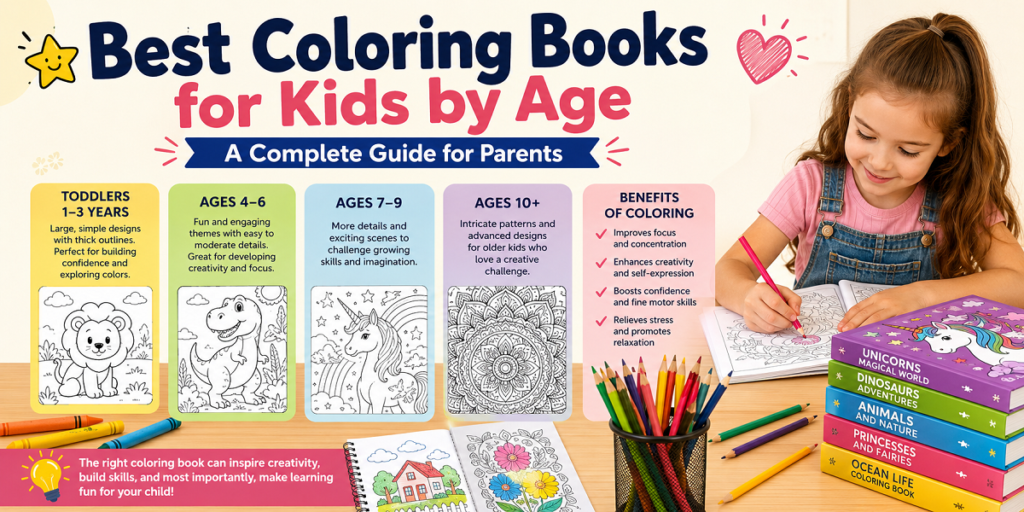
Coloring for Different Age Groups
The best coloring activity depends on the person’s age and skill level.
| Age Group | Suitable Designs | Main Focus |
|---|---|---|
| Toddlers | Large simple objects | Color exploration |
| Ages 4–6 | Animals, vehicles, characters | Creativity |
| Ages 7–9 | Fantasy and detailed scenes | Imagination |
| Ages 10+ | Patterns and detailed artwork | Creative challenge |
| Teens | Aesthetic, fantasy, nature | Self-expression |
| Adults | Mandalas, flowers, cozy scenes | Creative relaxation |
These are general guidelines. Personal interests should always be considered when selecting a coloring book.
How to Make Coloring More Interesting
You don’t have to simply color a page from beginning to end.
Try these ideas.
Create a Color Challenge
Choose five colors and try to complete the entire page using only those colors.
Make a Story
After finishing a fantasy illustration, create a short story about the characters.
Try Different Color Palettes
Print the same page twice and use completely different color combinations.
Add Backgrounds
If the coloring page has an open background, add grass, clouds, stars, flowers, trees, or other details.
Color Together
Invite friends, siblings, parents, or children to work on their own pages at the same time.
Choosing the Right Coloring Book
The benefits of coloring are easier to enjoy when the artwork matches the person using it.
Consider:
Age
Choose illustrations appropriate for the user’s developmental stage and coloring experience.
Interests
Animals, dinosaurs, fantasy, flowers, vehicles, nature, fashion, and cozy scenes can appeal to different people.
Difficulty
Beginners usually benefit from simpler designs, while experienced colorists may prefer intricate artwork.
Format
Printable coloring books provide flexibility, while physical books are convenient when you want something ready to use.
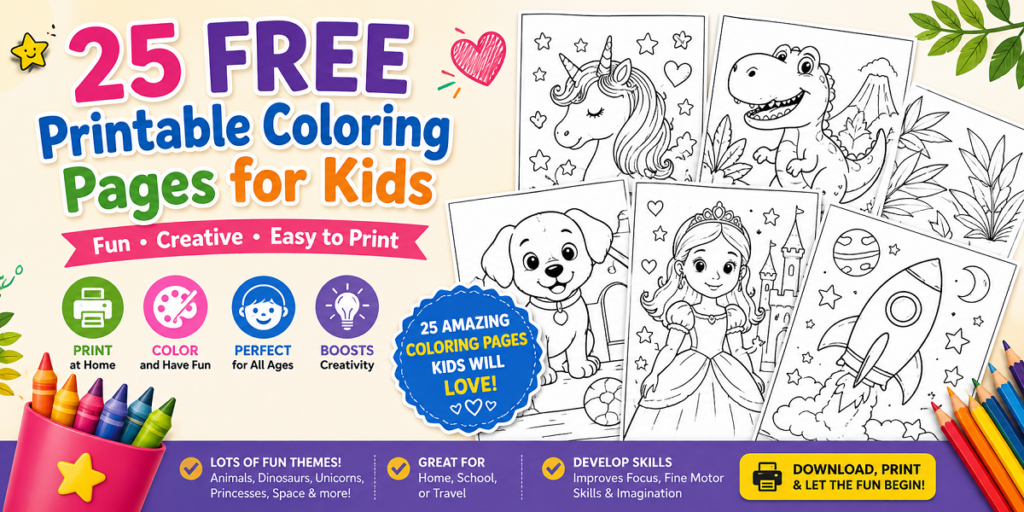
Printable Coloring Books for Creative Activities
Printable coloring books are particularly useful for families, teachers, and anyone who wants access to different designs without storing multiple physical books.
You can print only the pages you want and save the remaining designs for later.
They can also be useful for:
- Weekend activities
- School projects
- Holiday activities
- Children’s parties
- Travel activities
- Rainy days
- Family creative sessions
Choose good-quality paper based on the coloring tools you plan to use.
Frequently Asked Questions
Is coloring good for children?
Coloring can be a useful creative activity for children. It provides opportunities to practice controlled hand movements, explore colors, express ideas, and use imagination.
Can adults enjoy coloring books?
Absolutely. Adults can choose from mandalas, flowers, animals, fantasy scenes, nature designs, cozy illustrations, and many other themes.
Does coloring improve creativity?
Coloring gives people opportunities to make decisions about colors, patterns, compositions, and visual details. These choices can encourage creative expression.
What type of coloring book is best for beginners?
Beginners often find simple illustrations with clear outlines and larger coloring areas easier to work with than highly intricate designs.
Are printable coloring pages useful for kids?
Yes. Printable pages make it easy to select age-appropriate designs and print new activities whenever needed.
Can coloring be a family activity?
Yes. Parents, children, and siblings can color together, discuss their artwork, and create stories around the pictures.
Final Thoughts
Coloring is a simple creative activity, but it offers much more than simply putting color on a page.
For children, it can provide opportunities to practice hand control, explore creativity, develop imagination, and enjoy screen-free activities. For teens and adults, it can become an enjoyable hobby that encourages self-expression and creative exploration.
The best part is that you don’t need to be an artist.
Choose a coloring page that interests you, pick a few colors, and start creating. There are no rules saying a flower has to be pink or a dragon has to be green.
Choose your colors, use your imagination, and make every page your own.
Explore ColoringBookArt.com for printable coloring books and creative designs for kids, teens, and adults.