Choosing a coloring book for a child sounds simple, but with so many themes, designs, and difficulty levels available, it can be difficult to know which one is actually right.
The best coloring book should be enjoyable, age-appropriate, and interesting enough to keep a child engaged. A toddler may need large, simple pictures, while an older child might prefer detailed fantasy scenes or creative patterns.
Whether you’re buying a physical book or choosing a printable coloring book, this guide will help you find the right option for your child.
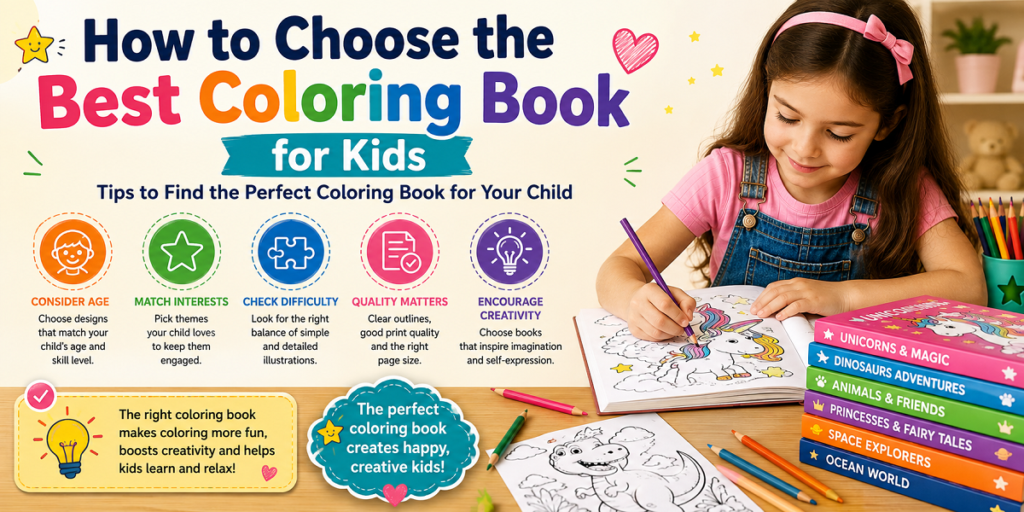
Quick Answer: What Makes a Good Coloring Book for Kids?
A good children’s coloring book should match the child’s age, interests, skill level, and attention span.
Look for:
- Age-appropriate illustrations
- Clear and easy-to-follow outlines
- Themes the child already enjoys
- A suitable level of detail
- High-quality printable pages
- Enough variety to maintain interest
- Designs that encourage creativity
The right choice doesn’t have to be the most expensive book. It simply needs to be a good match for the child.
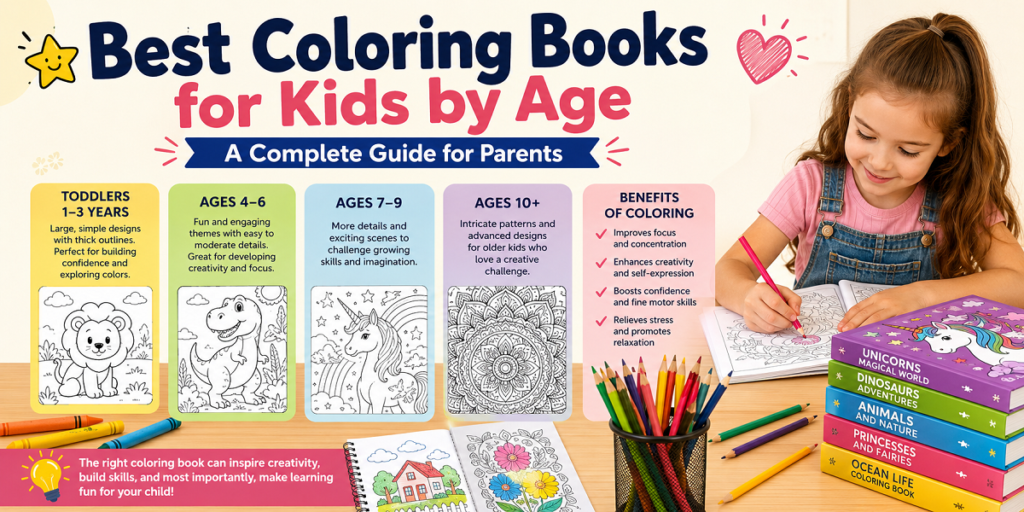
1. Choose a Coloring Book Based on Age
Age is one of the most important factors.
Coloring Books for Toddlers
Toddlers are still developing hand control, so simple designs work best.
Look for:
- Large pictures
- Thick outlines
- Simple shapes
- Familiar objects
- Large areas to color
Animals, fruits, toys, vehicles, and basic shapes are popular choices.
Coloring Books for Ages 4–6
Children in this age group can usually handle more recognizable scenes and slightly more detail.
Good themes include:
- Dinosaurs
- Animals
- Princesses
- Unicorns
- Cars
- Fairies
- Space
- Alphabet and numbers
Choose designs that are interesting without containing too many tiny areas.
Coloring Books for Ages 7–9
Older children can begin exploring more detailed artwork.
Fantasy adventures, wildlife, underwater scenes, magical worlds, and character-based illustrations can provide more creative opportunities.
Coloring Books for Ages 10+
Children around this age may enjoy sophisticated artwork with detailed patterns, fantasy landscapes, nature scenes, animals, and more intricate illustrations.
The important thing is not to assume that every older child wants difficult designs. Personal interests still matter.
2. Think About Your Child’s Interests
The best coloring book is often the one that features something the child already loves.
A dinosaur fan might spend much more time with a dinosaur coloring book than a generic collection of shapes.
Ask yourself:
What does the child enjoy?
If they love animals, consider wildlife, pets, ocean animals, or farm animals.
If they enjoy fantasy, look for unicorns, dragons, fairies, castles, and magical worlds.
If they’re interested in vehicles, choose cars, trucks, trains, airplanes, or construction equipment.
Other popular themes include:
- Space
- Nature
- Ocean life
- Superheroes
- Fairy tales
- Flowers
- Insects
- Food
- Holidays
Matching the subject to the child’s interests can make coloring feel like play rather than a task.
3. Check the Difficulty Level
Difficulty is just as important as the theme.
A coloring page with hundreds of tiny sections may frustrate a young child. On the other hand, a very basic picture might not challenge an older child.
Before choosing a book, look at several sample pages.
Ask:
- Are the illustrations easy to understand?
- Are the outlines clear?
- Are the coloring areas large enough?
- Is there too much detail?
- Will the child be able to complete a page without becoming frustrated?
A good coloring book provides an appropriate challenge without taking away the fun.
4. Look for Clear, High-Quality Illustrations
The quality of the artwork matters, particularly with printable coloring books.
Look for clean outlines without unnecessary clutter. Images should remain sharp when printed, and the design should be easy for children to follow.
For printable coloring books, check whether the pages are designed for common paper sizes and whether the file provides good print quality.
Clean black-and-white line art is usually easier for children to color than artwork with excessive shading or complicated backgrounds.
5. Choose the Right Page Size
Page size can affect the coloring experience.
Younger children generally benefit from larger illustrations and plenty of space to color.
For printable pages, standard paper sizes are convenient because they can be printed at home without complicated settings.
A well-designed page should use the available space effectively rather than placing a very small illustration in the middle of a large blank page.
6. Consider the Number of Pages
More pages don’t automatically mean a better coloring book.
A 50-page book filled with repetitive designs may be less interesting than a 25-page collection containing a variety of creative illustrations.
Look for variety in:
- Characters
- Scenes
- Difficulty
- Themes
- Composition
A collection should give children enough options to discover something they enjoy.
7. Printable Coloring Books vs. Physical Books
Both formats have advantages.
| Feature | Printable Coloring Book | Physical Coloring Book |
|---|---|---|
| Convenience | Print when needed | Ready to use |
| Variety | Easy to select pages | Fixed collection |
| Storage | Digital | Physical |
| Reprinting | Possible | Not normally possible |
| Customization | Choose selected pages | Use included pages |
| Portability | Depends on device/printer | Easy to carry |
Printable coloring books are particularly useful for parents who want to print only the pages their children are interested in.
They can also be useful for teachers, homeschool activities, children’s parties, and rainy-day projects.
8. Choose Designs That Encourage Creativity
Coloring shouldn’t always be about staying inside the lines.
Look for illustrations that give children opportunities to make creative decisions.
For example, a fantasy scene can allow a child to decide:
- What color the dragon should be
- Which colors belong on the castle
- What the sky should look like
- How the characters should dress
- What colors to use for magical objects
There isn’t necessarily one “correct” way to color a creative illustration.
9. Consider Educational Coloring Books
Some coloring books combine creativity with learning.
Educational coloring books can introduce:
- Letters
- Numbers
- Shapes
- Animals
- Plants
- Countries
- Dinosaurs
- Space
- Basic science concepts
For younger children, an alphabet coloring book can make learning letters more interactive. Older children may enjoy nature, science, or geography-related themes.
The best educational coloring books don’t feel like homework. They combine learning with an enjoyable creative activity.
10. Look at the Overall Design of the Book
Don’t judge a coloring book only by its cover.
If previews are available, check the inside pages.
Look for consistent artwork, good spacing, clear outlines, and a sensible progression of difficulty.
For online coloring books, also check whether the product description clearly explains:
- Number of pages
- Recommended age
- File format
- Page size
- Printing instructions
- Whether the book is printable
This information helps parents make a more informed decision.
Best Coloring Book Themes for Different Children
| Child’s Interest | Recommended Theme |
| Animals | Pets, wildlife, farm animals |
| Dinosaurs | Dinosaurs and prehistoric scenes |
| Fantasy | Unicorns, dragons, fairies |
| Vehicles | Cars, trucks, trains |
| Space | Rockets, planets, astronauts |
| Nature | Flowers, forests, landscapes |
| Fairy tales | Castles, princesses, magical scenes |
| Science | Animals, planets, nature |
| Art | Patterns and detailed designs |
How to Make Coloring More Fun
Once you’ve found the right book, make the activity more creative.
Give children different coloring tools such as crayons, colored pencils, or washable markers.
You can also turn each page into a small storytelling activity.
For example, after a child colors a picture of a dragon, ask:
“Where does your dragon live?”
Or after coloring a spaceship:
“Where is your spaceship going?”
This encourages children to use their imagination and create stories around their artwork.
You can also display finished pages around the home. Children often enjoy seeing their artwork treated like a real piece of art.
Common Mistakes to Avoid
When choosing a coloring book, avoid selecting one based only on popularity.
A few common mistakes include:
Choosing a book that’s too difficult:
Tiny details can frustrate younger children.
Choosing a book that’s too simple:
Older children may lose interest quickly.
Ignoring the child’s interests:
A beautiful book isn’t useful if the child doesn’t enjoy its theme.
Buying without checking sample pages:
The cover doesn’t always represent the interior artwork.
Focusing only on page count:
Quality and variety are more important than simply having more pages.
Frequently Asked Questions
What is the best coloring book for a 5-year-old?
Look for coloring books with simple but engaging illustrations, clear outlines, and familiar themes such as animals, dinosaurs, vehicles, unicorns, and fairy tales.
Are printable coloring books good for children?
Yes. Printable coloring books are convenient because parents can print selected pages whenever they’re needed and choose themes based on a child’s interests.
What should I look for in a coloring book for toddlers?
Choose books with large, simple illustrations, thick outlines, and plenty of open space. Avoid designs with excessive small details.
What coloring books are good for older kids?
Older children may enjoy fantasy scenes, animals, nature, detailed patterns, magical worlds, and other artwork with a greater level of detail.
Are coloring books educational?
They can be. Coloring books can be combined with learning activities involving letters, numbers, animals, nature, science, and storytelling.
Final Thoughts
Choosing the best coloring book for kids comes down to finding the right balance between age, difficulty, interests, artwork quality, and variety.
Start with the child’s interests, then choose illustrations that match their skill level. Younger children usually need simple designs, while older children can explore more detailed scenes and creative patterns.
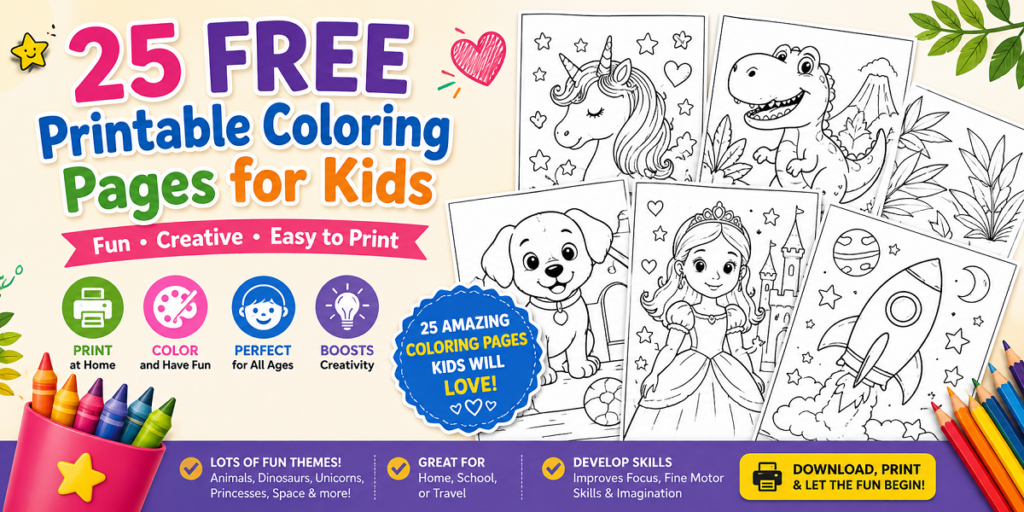
If you’re looking for convenient options, printable coloring books make it easy to choose individual pages and print them at home.
Most importantly, give children room to experiment. The best coloring book isn’t necessarily the one with the most complicated artwork—it’s the one that makes a child excited to pick up their crayons and start creating.
Explore more kids’ coloring books and printable coloring pages at ColoringBookArt.com.